



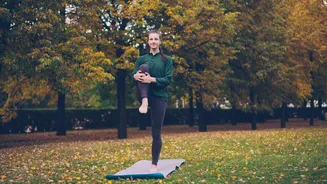
The Power of a Focused Gaze (Drishti)
The single most effective tool for maintaining balance is your 'drishti', a Sanskrit term for a focused gaze. Instead of letting your eyes wander, find a single, unmoving point in front of you and rest your gaze there softly. This could be a spot on the wall
or a speck on the floor. A steady gaze helps to quiet the mind's chatter and signals to your nervous system that you are stable. When your eyes are still, your body has a fixed reference point, making it far easier to adjust to the tiny wobbles and shifts that happen when balancing on one leg. Think of it as an anchor for your mind, which in turn anchors your body. If you find your thoughts drifting or your balance wavering, gently bring your focus back to your drishti.
Build Your Foundation from the Ground Up
A tree is only as strong as its roots. In Tree Pose, your standing foot is your root system. Begin in Mountain Pose (Tadasana) and consciously shift your weight onto one foot, spreading your toes and grounding down through all four corners of the foot. This creates a stable base. Engage the muscles of your standing leg by lifting the kneecap and firming the thigh. This 'zipping up' action provides the structural support needed to hold the pose. Avoid gripping with your toes, as this can create tension and instability. The standing leg shouldn't be locked; a micro-bend in the knee can prevent hyperextension and help with shock absorption.
Engage Your Core for Central Stability
While the standing leg provides the foundation, your core is the strong trunk of your tree. Engaging your abdominal muscles is crucial for stabilizing your entire torso and preventing you from tipping over. Gently draw your navel in toward your spine to activate your deep core muscles. This action supports your lower back and keeps your hips level, which is a common area of misalignment. Many people make the mistake of letting the hip of the standing leg pop out to the side, which throws off the body's center of gravity. By keeping your core engaged, you create a solid, integrated line of energy from your standing foot all the way to the crown of your head, making balance feel less like a struggle and more like an organized effort.
Let Your Breath Be Your Guide
Holding your breath is a natural response when concentrating, but it creates tension and works against your balance. A steady, even breath calms the nervous system and fosters a state of relaxed focus. In yoga, the breath is seen as the bridge between the body and mind. Try to coordinate your breath with your movements: inhale to lengthen your spine, and exhale to ground down through your standing foot. A slow, controlled breath, like the Ujjayi breath common in yoga, can help regulate your energy and maintain composure, even when the pose feels challenging. If you start to wobble, bring your attention back to the rhythm of your inhales and exhales.
Embrace Variations and Imperfection
There is no 'perfect' Tree Pose, only the version that is right for your body today. If you're struggling, don't be afraid to modify. Use a wall or chair for support, lightly placing a hand to steady yourself. The position of your lifted foot can also be adjusted. Instead of placing it high on the inner thigh, you can rest it on your calf or even keep your toes on the floor with your heel on your ankle. The most important rule is to never place your foot directly on the knee joint, as this puts sideways pressure on it. Remember that wobbling is part of the process; it's your body learning to make micro-adjustments. Some days you will feel stable, and other days you won't. The goal is not to avoid falling, but to practice returning to your center with patience and self-compassion.