

A Whirlwind Discovery
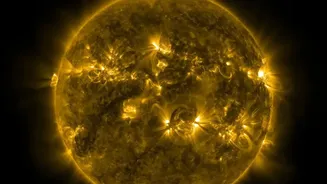
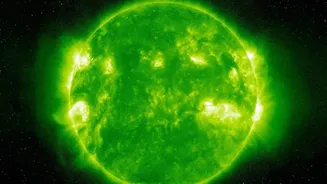
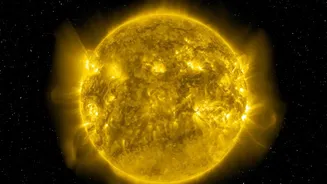
In a groundbreaking series of observations, astronomers have captured the highest-resolution images of the sun's surface ever taken. These images, produced by the Daniel K. Inouye Solar Telescope in Hawaii, revealed tiny, swirling vortices of plasma at the edges
of the sun's bubbling granules. These whirlpool-like structures are the first direct evidence of a phenomenon known as the Kelvin-Helmholtz instability on the sun's visible surface. This instability occurs when two fluids, or in this case, layers of plasma, move past each other at different speeds, creating a shear force that develops into waves and spirals. The effect is common on Earth, visible in ocean waves and cloud formations, but seeing it on our star is a major breakthrough.
What Makes These Waves Special?
The incredible power of the Inouye telescope allowed scientists to see structures as small as 20 kilometres wide on the sun's surface—a feat likened to spotting a small coin from over 100 kilometres away. It was at this unprecedented level of detail that the plasma vortices became visible. Researchers from institutions like the Max Planck Institute for Solar System Research were stunned by the clarity of the data. For years, scientists had theorized that Kelvin-Helmholtz instabilities must occur on the sun, but they had never been directly observed. These newly seen waves are not just a confirmation of a long-held theory; they are a window into the fundamental physics that govern our star. The discovery shows how energy is transferred and transformed at a granular level, revealing a key piece of the solar puzzle.
Decoding the Sun's Fiery Engine
The discovery of these mini-vortices has profound implications for understanding the sun's most energetic behaviours. Scientists believe these instabilities play a crucial role in moving and twisting the sun's magnetic field lines. Think of it like coiling a metal spring; the twisting motion builds up immense tension and stores magnetic energy. This stored energy can then be suddenly released, potentially contributing to dramatic events like solar flares and coronal mass ejections (CMEs). Furthermore, the efficient mixing of magnetized and non-magnetized plasma by these vortices could explain how the sun's magnetic field changes so rapidly over its 11-year activity cycle, a process that existing models have struggled to account for.
The Earth Connection: Predicting Space Weather
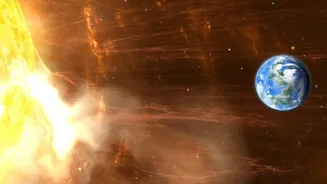
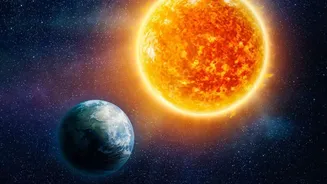
While these phenomena occur 150 million kilometres away, their study is vital for life on Earth. The solar flares and CMEs that may be powered by these instabilities can send massive clouds of charged particles hurtling toward our planet. These events create what is known as space weather. Severe space weather can disrupt our satellite-based technologies, including GPS navigation, communications networks, and even power grids on the ground. By better understanding the root causes of these solar outbursts, such as the swirling plasma waves now being observed, scientists can improve their models for predicting space weather. This gives us a better chance to prepare for and mitigate the potential impacts of a powerful solar storm.