

A Galaxy Right Next Door
When you gaze at the Andromeda galaxy, you're looking at the most distant object the human eye can see without aid. Located about 2.5 million light-years away, it’s our closest major galactic neighbor. To put that distance in perspective, the light hitting
your eyes tonight left Andromeda when our earliest human ancestors were first walking the Earth. This isn't a single star or a planet; it's a sprawling city of stars, home to perhaps a trillion of them, compared to our Milky Way's estimated 200-400 billion. Its sheer size is immense. If it were brighter in our sky, it would appear six times wider than the full moon.
The Autumn Viewing Window
Andromeda becomes a primetime celestial target in the autumn for observers in the Northern Hemisphere, including India. During these months, the Earth's position in its orbit gives us a clear, high-in-the-sky view. The galaxy rises in the east after sunset, climbs to its highest point overhead around midnight through October and November, and remains visible until it sets in the west in the early months of the new year. This positioning lifts it above the thickest, haziest parts of our atmosphere, offering a clearer path for its ancient light to reach us.
What You Will Really See
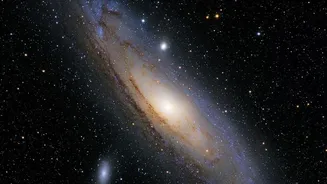
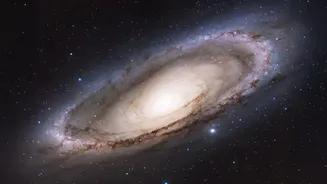
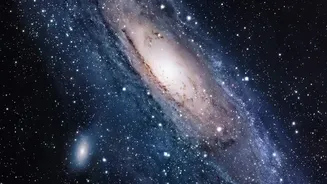
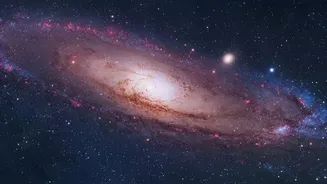
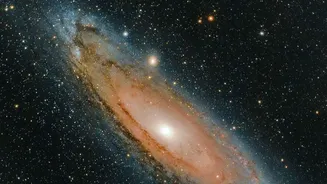
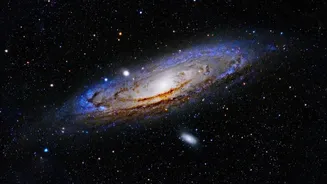
The headline mentions a “glowing spiral disk,” but it’s important to manage expectations. The iconic spiral arms, with their dramatic dust lanes, are features that only reveal themselves in long-exposure astrophotography. To the naked eye in a very dark, rural sky, Andromeda appears as a faint, fuzzy patch of light, easily mistaken for a small, wispy cloud. Through a pair of basic binoculars, that faint smudge transforms into something much more defined: a distinct, elongated, oval-shaped glow. This bright patch is the galaxy's core, or central bulge, where millions of stars are packed closely together. While you won’t see the spiral structure, you are unmistakably seeing the concentrated heart of another galaxy.
How to Find This Celestial Marvel
Finding Andromeda for the first time is a rewarding challenge. The easiest way is to use brighter, more familiar constellations as signposts. One popular method involves the W-shaped constellation Cassiopeia. The 'V' on one side of the 'W' acts like an arrow, pointing roughly in Andromeda's direction. Another common technique starts with the Great Square of Pegasus. From the corner star of the square, Alpheratz, you can 'star-hop' along the chain of stars that forms the constellation Andromeda until you land on the faint, misty patch of the galaxy nearby. Using binoculars to slowly scan this area of the sky is the most effective way to spot it, even from areas with moderate light pollution.
The Science of the Galactic Glow
That soft, ethereal glow is not solid light but the combined radiance of hundreds of billions of stars. They are so incredibly far away that your eyes and even standard binoculars cannot resolve them into individual points. Instead, their light blends together into a diffuse haze. The reason the core appears so much brighter is due to the sheer density of stars there. Many of these are older, evolved stars that give the central bulge a slightly yellowish hue in photographs. Binoculars are the perfect tool for appreciating this sight because their wide field of view allows you to see the galaxy in the context of its surrounding starfield, something often lost in the narrow, high-magnification view of a telescope. Some observers might even spot M32, one of Andromeda's smaller satellite galaxies, appearing as a tiny, fuzzy 'star' right next to the main glow.