


What is Vocal Learning?
Vocal learning is the ability to learn to produce new sounds through imitation, a skill that is surprisingly uncommon in the animal kingdom. While most animals are born with a fixed set of sounds they can make, vocal learners can hear a sound and replicate
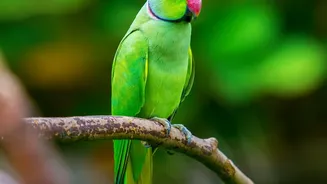
it. This group is quite exclusive, including humans, some marine mammals like dolphins and whales, bats, elephants, and only three groups of birds: songbirds, hummingbirds, and parrots. Among these, parrots are considered the most advanced vocal mimics. Unlike a dog that can learn to understand commands but can only bark, a parrot can modify its vocalisations based on what it hears, which is the foundation of its ability to 'talk'.
A Uniquely Wired Brain
The secret to the parrot's exceptional talent lies in the unique structure of its brain. All vocal-learning birds have a specialised part of the brain called the 'song system'. However, research led by neuroscientist Erich Jarvis at Duke University revealed that the parrot's brain has a distinct arrangement. It features what scientists describe as a 'core' and 'shell' structure. The inner 'core' is similar to what's found in other songbirds and hummingbirds. But the outer 'shell' region is unique to parrots and is believed to be responsible for their superior ability to imitate a wide range of sounds, including human speech. This specialised neural architecture provides the hardware for their impressive vocal skills.
The Song System Shell
This 'shell' system seems to be the key differentiator. Studies have found that the shell regions are relatively larger in parrot species renowned for their ability to imitate human speech, like the African Grey parrot. While the core is involved in producing learned vocalisations, the shell adds another layer of complexity that enhances this ability. Scientists believe this dual-layered system is a product of convergent evolution, where similar traits evolve independently in species that are not closely related. The brain pathways for vocal learning in parrots show remarkable similarities to those in humans, even more so than the brains of non-human primates. This suggests that nature arrived at a similar solution for complex vocal skills in both humans and parrots, despite our vastly different evolutionary paths.
The Power of Social Connection
Biology is only part of the story; sociology plays a crucial role too. Parrots are highly social creatures. In the wild, they use their vocal learning abilities to develop unique calls that help them fit in with their flock and strengthen social bonds. When a parrot is brought into a human household, its human family becomes its flock. The drive to fit in and communicate remains the same. The parrot listens to the sounds of its new 'flock'—the words and phrases spoken by people—and begins to mimic them as a way to interact and bond. They are particularly drawn to words spoken with enthusiasm or that elicit a strong reaction, which reinforces the behaviour.
Do They Know What They're Saying?
The question of comprehension is complex. While parrots may not understand grammar or abstract concepts in the same way humans do, they are intelligent enough to use words in context. Famous studies, such as those with an African Grey parrot named Alex, showed that parrots can learn to associate words with objects, colours, and actions. A pet parrot might say 'want nut' when it sees you with a treat or 'good morning' when you uncover its cage. This demonstrates an ability to connect a specific sound with a specific outcome or situation, moving beyond simple repetition to a form of meaningful communication. This contextual use of words highlights a cognitive capacity that makes their vocal skills even more impressive.