






The Brutal Physics of Reentry
Any object entering a planet’s atmosphere faces a colossal challenge. A probe returning from Mars or an asteroid hits Earth's atmosphere at speeds that can exceed 18,000 miles per hour. This incredible velocity creates immense friction with air molecules,
generating temperatures hot enough to melt most metals. For decades, space agencies have relied on rigid, ablative heat shields — think of the cone-shaped capsules of the Apollo missions. These shields are coated in materials that burn away in layers, carrying heat with them. While effective, this approach has a fundamental limitation: size. A traditional heat shield cannot be wider than the rocket fairing it launches in, which restricts how much drag it can create and, therefore, how heavy a payload it can safely land.
Thinking Outside the Rocket Cone
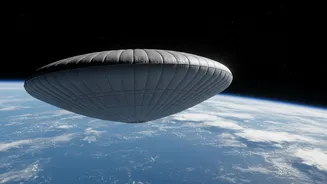
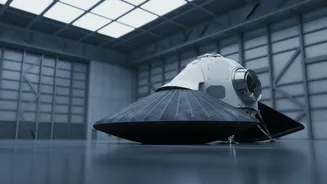
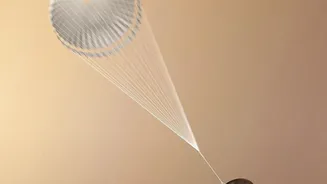
This is where inflatable heat shields, officially known as Hypersonic Inflatable Aerodynamic Decelerators (HIADs), come in. The concept is brilliantly simple: launch a heat shield that is packed down compactly, then inflate it in space just before it needs to do its job. This allows for a shield that is much larger in diameter than a rigid one — creating significantly more drag. More drag means the spacecraft can slow down more effectively, especially in thin atmospheres like Mars, or it can be used to land much heavier payloads, like future human-rated landers or large sample-return missions. This technology has been in development for over a decade, but a recent successful test has proven its readiness for ambitious future missions.
Proof of Concept: The LOFTID Mission
In November 2022, NASA successfully tested a six-meter HIAD called the Low-Earth Orbit Flight Test of an Inflatable Decelerator, or LOFTID. Launched as a secondary payload, LOFTID inflated in orbit and then purposefully reentered the atmosphere, surviving the extreme environment before splashing down in the Pacific Ocean. Declared a “huge success” by NASA, the demonstration proved that the inflatable structure could withstand the intense heat and aerodynamic forces of reentry. The test provided crucial data, showing that the technology is now viable for missions to Mars, Venus, Titan, and for returning large assets to Earth.
The Advanced Materials That Make It Possible
An inflatable heat shield is far more than just a high-tech balloon. It is a multi-layered system of advanced materials. The outermost layer, which faces the intense reentry heat, is a flexible fabric woven from ceramic silicon carbide fibers. This material can withstand temperatures up to nearly 3,000 degrees Fahrenheit. Beneath this ceramic skin are layers of flexible insulation to keep the heat from penetrating further. The inflatable structure itself is composed of stacked rings, or tori, woven from a synthetic polymer that is, by weight, significantly stronger than steel. These rings are pliable enough to be folded for launch but become incredibly rigid when inflated, providing the structural strength needed to maintain the shield's shape against immense aerodynamic forces.
Unlocking the Future of Space Exploration
The success of HIAD technology opens up a new range of possibilities for space exploration. For Mars, a larger decelerator is critical for landing heavier robotic explorers, science labs, and eventually, the cargo needed to support human astronauts. The thin Martian atmosphere makes slowing down particularly difficult, and a larger drag area is a game-changer. Beyond Mars, inflatable shields could enable missions to Venus or Saturn’s moon Titan, both of which have thick atmospheres. The technology also has applications closer to home, offering a cost-effective way to return large components from low-Earth orbit, including reusable rocket stages or materials manufactured in space. By solving one of the biggest constraints in spacecraft design — the size of the heat shield — inflatable decelerators are set to become a cornerstone technology for the next era of discovery.