


The Universe's Baby Pictures
For decades, scientists have relied on a standard story for how the universe grew up. This narrative, known as the Lambda-CDM model, has been incredibly successful at explaining everything from the cosmic microwave background to the large-scale structure
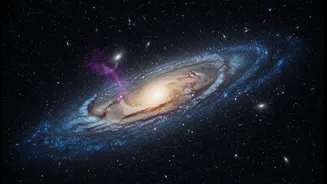
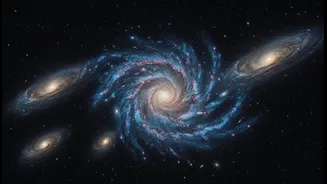
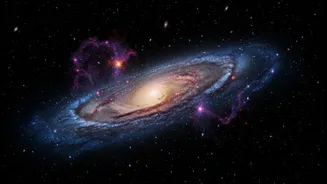
of galaxies. According to this model, the first galaxies should have been small, messy, and chaotic. They were the cosmic equivalent of tiny streams, gradually merging and growing over billions of years to form the grand, majestic galaxies we see today, like our own Milky Way. The expectation was clear: looking back to the dawn of time, we should find galactic infants, not fully-formed adults.
A Cosmic Growth Spurt
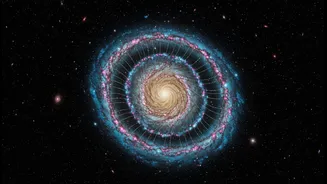
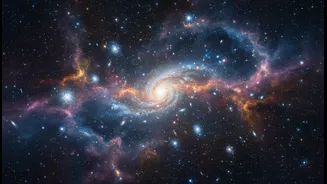
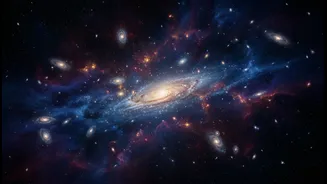
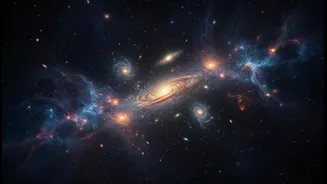
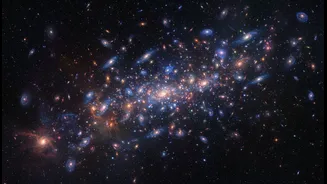
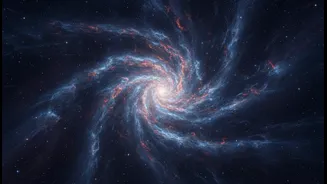
Then came the James Webb Space Telescope (JWST). With its unprecedented power to peer into the farthest reaches of space and time, it started sending back images that left astronomers stunned. Instead of the expected pipsqueaks, JWST found galaxies from the cosmic dawn—just a few hundred million years after the Big Bang—that were surprisingly massive, bright, and structured. Some of these ancient galaxies already had flattened, rotating disks and were unexpectedly rich in heavy elements like oxygen and carbon, materials that should have taken generations of stars to produce. Even more surprising were discoveries of complex mergers and galaxies that showed no signs of rotation at all, features thought to take billions of years to develop.
Rewriting the Cosmic Rulebook
This discrepancy isn't just a minor detail; it poses a significant challenge to our fundamental understanding of cosmology. The standard model simply doesn't allow for galaxies to assemble and mature so quickly. If these observations hold true, it means something in our cosmic rulebook is either wrong or incomplete. The puzzle forces scientists to question core assumptions: How fast can stars truly form? How quickly do supermassive black holes at the centers of galaxies grow and influence their surroundings? The existence of these 'impossible early galaxies' suggests that the engine of galaxy formation was running far faster and more efficiently than anyone predicted.
The Hunt for an Explanation
In the face of this cosmic mystery, scientists are exploring several intriguing possibilities. One leading idea is that some of these galaxies aren't as massive as they appear. New research suggests that hyperactive supermassive black holes at their centers could be making them look much brighter. The intense light from gas being consumed by the black hole can be mistaken for light from a much larger population of stars. Another theory is that star formation in the early universe was far more explosive, occurring in intense 'bursts' that quickly built up galaxies. More radical ideas propose tweaks to the standard model itself, perhaps suggesting the nature of dark matter or the very expansion of the universe might be different from what we assume, potentially giving the universe more time to form these structures.
What Happens Next?
While the presence of active black holes helps explain some of the brightest 'little red dots', a puzzle remains: there still seem to be more large galaxies than models predict. The investigation is far from over. Astronomers are now using JWST to gather more detailed data from an even larger sample of early galaxies. They are performing deep surveys to confirm distances and analyze the chemical makeup and motion of gas within these systems. Each new piece of data is a clue in this grand detective story. The goal is to determine whether our theories of star and black hole formation need a major overhaul or if the very foundation of cosmology needs to be reconsidered.