



The Brains Behind the Mission
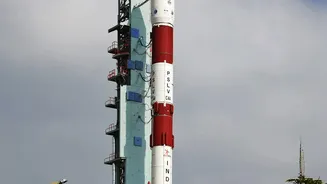
Long before a rocket ever leaves the launchpad, its journey has been simulated countless times. This is the world of High-Performance Computing (HPC), the bedrock of modern space exploration. For the Indian Space Research Organisation (ISRO), supercomputers
are essential tools for everything from designing rockets to calculating complex orbital trajectories. These powerful systems run thousands of simulations to ensure mission parameters are perfect, reducing risks and increasing the chances of success. But their role is expanding beyond pre-flight checks. As Indian satellites gather more data than ever before, HPC, combined with artificial intelligence, is becoming crucial for processing this information on a massive scale, turning raw numbers into actionable insights for weather forecasting, urban planning, and resource management.
AI for Smarter, Safer Spacecraft
Artificial Intelligence (AI) and Machine Learning (ML) are transitioning from theoretical concepts to practical realities within ISRO’s operations. One of the most significant applications is in creating more autonomous and intelligent spacecraft. The successful soft landing of Chandrayaan-3, for example, relied on AI-powered sensors and cameras to analyse the lunar surface in real-time, identify hazards, and navigate to a safe landing spot. This capability is vital for future missions, including robotic explorations and the Gaganyaan human spaceflight program. AI systems are being developed to monitor the health of spacecraft and launch vehicles, predict potential anomalies from telemetry data, and manage space traffic to avoid collisions, making missions significantly safer and more reliable.
Processing Data at the Edge
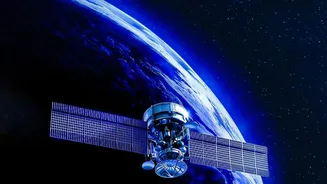
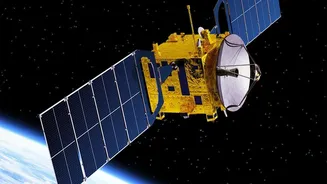
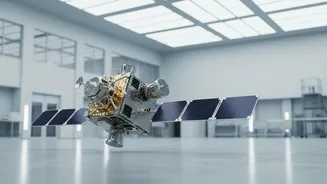
One of the biggest challenges in space is the sheer volume of data collected by satellites. Transmitting all of this raw data back to Earth is slow and expensive. The solution is 'space edge computing', a concept ISRO is actively exploring. This involves placing AI and ML capabilities directly onto the satellites themselves. By processing data in orbit, the satellite can analyse images and sensor readings on the spot, identify important events—like a natural disaster or changes in forest cover—and send back only the critical information. This dramatically reduces delays and enables faster decision-making for time-sensitive applications, from disaster management to national security surveillance. ISRO has already announced plans for AI-powered satellites that can interact with each other to gather intelligence more effectively.
The Coming Quantum Frontier
Looking further ahead, quantum technology represents a paradigm shift for space exploration. India has invested significantly in this area through its National Quantum Mission (NQM), and ISRO is a key partner. The most immediate application is in secure communications. Quantum Key Distribution (QKD) technology can create virtually unhackable communication channels, which is essential for protecting sensitive military and government data transmitted via satellite. ISRO has already successfully demonstrated this technology over short distances. In the long term, quantum computers could solve complex optimization problems that are impossible for even the most powerful classical supercomputers, revolutionizing everything from new material design for spacecraft to coordinating entire constellations of satellites.