






What Is This 'Blaze Star'?
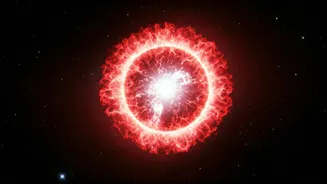
The star of the show is T Coronae Borealis (T CrB), nicknamed the 'Blaze Star'. Located about 3,000 light-years from Earth in the constellation Corona Borealis (the Northern Crown), T CrB isn't a single star. It's a binary system, meaning two stars are
locked in a close cosmic dance. One is a red giant, a bloated, aging star. The other is a white dwarf—the super-dense, collapsed core of a star that has used up its fuel. In essence, it's a 'dead star'. Normally, this system is far too dim to see with the naked eye. But T CrB is what’s known as a 'recurrent nova', a system that periodically erupts in a brilliant flash of light. The last time it happened was in 1946, and astronomers predict the next performance is imminent.
A Cosmic Vampire Story
The term 'awaken' is dramatic, but the science behind it is even more fascinating. Think of the white dwarf as a cosmic vampire. Its immense gravity continuously pulls, or 'accretes', material—mostly hydrogen—from the outer atmosphere of its larger red giant companion. This stolen gas piles up on the surface of the white dwarf, getting hotter and denser over time. For decades, this process continues silently. But once the accumulated layer reaches a critical point, the pressure and temperature trigger a runaway thermonuclear explosion. It's not an explosion that destroys the star, like a supernova. Instead, it’s a violent, cataclysmic eruption on the star's surface that blasts the accreted material into space.
The Coming Nova Explosion
When this explosion happens, T Coronae Borealis will brighten dramatically. Astronomers predict it will jump from its usual magnitude of +10 (far too faint for the naked eye) to around +2. This would make it as bright as Polaris, the North Star, and easily visible without a telescope from our backyards and rooftops, even in areas with some light pollution. This 'new' star will briefly join the familiar pattern of the Northern Crown before gradually fading back into obscurity over several days. The event provides a spectacular, real-time glimpse into the violent and dynamic life cycles of stars, a process that usually unfolds over millions or billions of years.
How and When to See It
The big question is when. While astronomers can't pinpoint the exact date, the window is now open, with predictions pointing to sometime between now and September 2024. The nova will be visible from the Northern Hemisphere, which includes all of India. To find it, you'll need to locate the constellation Corona Borealis, a small, C-shaped arc of stars located between the larger constellations of Boötes and Hercules. When the nova erupts, it will appear as a bright, temporary addition to this 'crown'. You won't need special equipment; for the first few days, it will be a naked-eye object. Afterwards, a good pair of binoculars will help you track it for a week or more as it fades. Numerous astronomy apps for your phone can help you locate the constellation in advance so you're ready when the news breaks.
A Once-in-a-Generation Spectacle
The 'historic' tag isn't hyperbole. With a cycle of roughly 80 years, seeing the T CrB nova is a true once-in-a-generation event. The last generation to witness it was in the aftermath of World War II. The next opportunity won't come until around the year 2104. This celestial event connects us to the past and the future, a rare moment where we can observe the same cosmic clockwork that our grandparents might have seen and that our grandchildren might one day witness. It's a powerful reminder that the universe is not a static backdrop but an ever-changing, active environment, and sometimes, we're lucky enough to get a front-row seat.