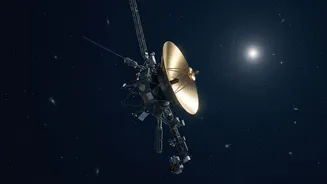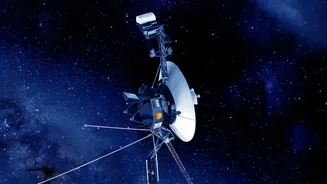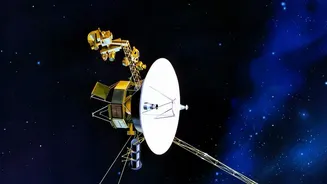


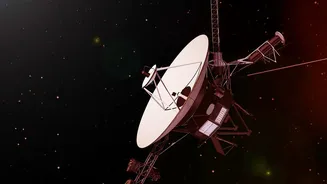
After nearly 50 years trekking through the cosmos, a lone emissary from Earth is about to cross an invisible, yet monumental, line. NASA's Voyager 1 is approaching a distance of one light-day, a first for any human-made object.
A Journey Beyond Imagination
On November 18, 2026, Voyager
1 will be so far from home that a radio signal, traveling at the fastest speed possible, will take a full 24 hours to reach it. This distance, known as a light-day, is equivalent to about 25.9 billion kilometers. To put that into perspective, it's roughly 173 times the distance from the Earth to the Sun. Launched on September 5, 1977, the spacecraft has been traveling at nearly 61,000 kilometers per hour, a velocity it achieved after a gravitational slingshot from Saturn in 1980. This milestone is not just a number; it represents the sheer scale of the void Voyager 1 has crossed and the incredible tenacity of a machine built in the 1970s, still whispering data back to its creators across an ocean of space.
The Grand Tour's Lasting Legacy
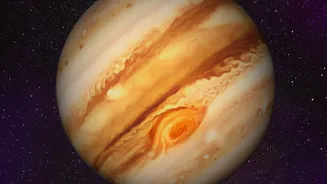
Voyager 1's original mission was a 'Grand Tour' of the outer solar system, a rare planetary alignment that allowed it to visit Jupiter and Saturn. It revolutionized our understanding of these gas giants. In 1979, it captured the first close-up images of Jupiter's Great Red Spot and, most stunningly, discovered active volcanoes erupting on the moon Io—the first ever found beyond Earth. A year later, it reached Saturn, discovering new moons and revealing the breathtakingly complex structure of its rings. After its planetary encounters, its trajectory flung it northward, out of the plane where the planets orbit, on a new path toward the space between stars. In 2012, it officially entered interstellar space, becoming the first human object to do so.
Humanity's Message in a Bottle
Affixed to the side of Voyager 1 is a special phonograph record, a 'Golden Record' intended as a greeting to any extraterrestrial civilization that might one day find it. It's a 12-inch, gold-plated copper disk containing a portrait of our world. The contents were selected by a committee led by famed astronomer Carl Sagan and include 115 images of life on Earth, from DNA structure to people eating and drinking. It also carries a montage of sounds, like wind, rain, and whale songs, plus 90 minutes of music from Bach to Chuck Berry. Spoken greetings in 55 different languages offer a message of peace from our small world. This record ensures that even after the probe goes silent, it will continue its journey as a silent ambassador for humanity.
A Faint Heartbeat from Deep Space
Keeping a nearly 50 year old probe alive is a monumental challenge. Voyager 1 runs on decaying plutonium, and its power supply diminishes by about four watts each year. To conserve energy, engineers have been methodically shutting down non essential systems, including its cameras, which took their final iconic 'Pale Blue Dot' image in 1990. Only two science instruments remain active today, studying the interstellar medium. The probe has given its ground team scares, including a recent communications blackout in October 2026, which the spacecraft autonomously resolved by switching to a backup set of thrusters. These events are a reminder that the mission is in its final chapter, relying on the ingenuity of its team and its own resilient design.