



The Silent Threat Above
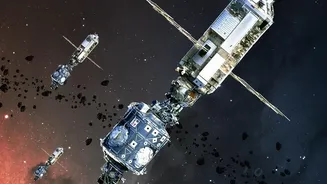
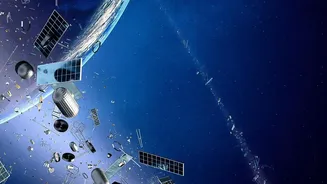
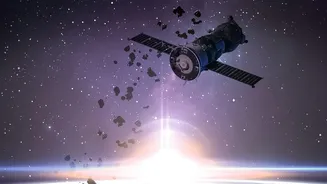
Space is not as empty as it looks. Decades of launches have left a legacy: millions of pieces of 'space junk' circling our planet. This debris includes everything from defunct satellites and spent rocket stages to tiny paint flecks. While a paint fleck might
sound harmless, in Low Earth Orbit (LEO), objects travel at speeds exceeding 28,000 kilometres per hour. At that velocity, even a centimetre-sized fragment carries enough kinetic energy to catastrophically damage or destroy a multi-crore satellite. This has created a treacherous environment for the more than 50 operational satellites India relies on for communication, navigation, weather forecasting, and national security. The Indian Space Research Organisation (ISRO) is performing an increasing number of collision avoidance manoeuvres (CAMs) each year, executing 20 such manoeuvres in 2025 alone to safeguard its assets.
The Digital Eyes: AI-Powered Surveillance
The first step in avoiding a collision is knowing it's coming. This is the domain of Space Situational Awareness (SSA), and it is where Artificial Intelligence is proving to be a game-changer. Historically, India relied on data from external agencies like the North American Aerospace Defense Command (NORAD). To achieve self-reliance, ISRO initiated Project NETRA (Network for space object TRacking and Analysis). This ambitious project is creating a network of radars and telescopes to track objects threatening Indian satellites. But tracking is only half the battle. Indian startups are now layering sophisticated AI on top of this data. Bengaluru-based Digantara, for example, uses AI-powered software to analyse orbital data, detect patterns, and predict potential collisions with far greater speed and accuracy than traditional statistical models. This system can sift through thousands of alerts, pinpointing the genuine threats and giving operators the crucial lead time needed to react.
The Agile Muscles: Advanced Propulsion
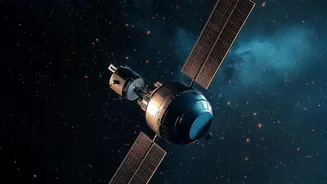
Once AI identifies a threat, the satellite must physically move out of the way. This is where the 'thrusters' come in. The headline's 'AI thrusters' refers to this two-part system: AI for detection and thrusters for action. Executing frequent avoidance manoeuvres requires engines that are not only precise but also highly efficient. Traditional chemical thrusters burn a lot of fuel, limiting a satellite's operational lifespan. This is why Indian startups are pioneering advanced electric propulsion systems. Bellatrix Aerospace, another Bengaluru-based innovator, has successfully developed and tested India's first privately-built Hall Thruster. These thrusters use electricity to ionize and accelerate gas, producing a gentle but persistent push with far greater fuel efficiency. This 'high mileage' propulsion allows a satellite to make many small adjustments over its lifetime without quickly exhausting its fuel, ensuring it can continue to dodge debris for years.
Building a Sovereign Shield
This combination of ISRO's strategic vision and the private sector's agile innovation is creating a sovereign capability for India in space safety. It's an ecosystem approach. ISRO sets the national agenda with programmes like Project NETRA and its goal of Debris-Free Space Missions. Meanwhile, startups like Digantara are building the advanced software and sensor networks for surveillance, while companies like Bellatrix Aerospace are perfecting the hardware for in-space mobility. This synergy is crucial. As space becomes more congested and contested, the ability to independently monitor and protect one's own assets is a significant strategic advantage. It ensures that India's vital space infrastructure—the backbone of its digital economy and security apparatus—remains secure and operational.