

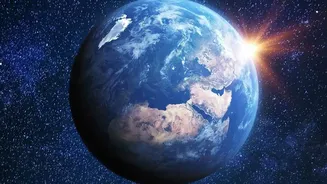
Our Only Example of a Living World
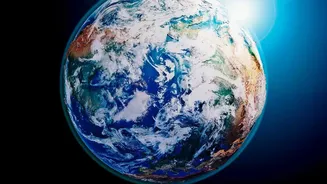
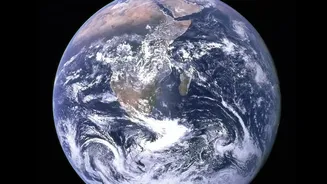
The simplest reason Earth is the primary reference in astrobiology is that it's our only confirmed example of a planet harbouring life. This makes it the foundational model for everything from planetary evolution to the chemical signatures life might
produce. While scientists are open to the possibility of life forms that are vastly different from our own, starting the search requires a template. Earth provides that template, giving researchers a known set of conditions and biological byproducts to look for among the stars. It's not about a lack of imagination, but about the necessity of having a starting point. Every search needs parameters, and in the quest for life, Earth provides the most crucial, data-rich ones we have.
Defining the 'Goldilocks Zone'
The concept of a 'habitable zone'—often called the Goldilocks Zone—is built around Earth. This is the region around a star where the temperature is just right for liquid water to exist on a planet's surface. Since every known life form on our planet requires liquid water, it has become the primary ingredient astrobiologists 'follow' in their search. The habitable zone's boundaries are determined by a star's brightness and a planet's atmosphere. A planet too close would see its water boil away, like on Venus, while one too far would freeze, like Mars. Earth's position in our solar system's habitable zone serves as the perfect demonstration of this delicate balance, making it the yardstick for assessing the potential of other worlds.
A Blueprint for Atmospheric Clues
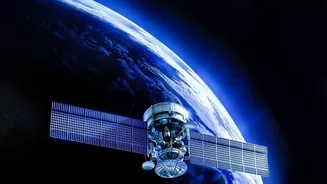
When telescopes like the James Webb Space Telescope (JWST) peer at distant exoplanets, they are primarily studying their atmospheres. Scientists look for 'biosignatures'—gases that could indicate the presence of biological processes. Earth's atmosphere provides the essential reference library for what to look for. Key targets include oxygen, methane, and carbon dioxide. On Earth, for example, the combination of methane and oxygen is a strong sign of life because these gases would normally react and destroy each other without being constantly replenished by living organisms. Recently, the potential detection of dimethyl sulfide (DMS) on the exoplanet K2-18b caused excitement because, on Earth, it is only produced by life, primarily marine phytoplankton. Without Earth as a guide, interpreting these faint atmospheric fingerprints would be nearly impossible.
More Than Just Water and Air
Habitability extends far beyond just temperature and atmosphere. Earth's other characteristics provide a more complex checklist for what makes a planet truly life-sustaining over billions of years. A crucial feature is a protective magnetic field, which shields the planet from harmful solar wind and cosmic rays that could strip away the atmosphere. This field is generated by the planet's active, molten core. Another vital element is plate tectonics. This geological process is not only involved in mountain formation but also plays a key role in regulating the planet's climate over geological timescales by cycling carbon between the atmosphere, oceans, and crust. These features, common to us but potentially rare elsewhere, show that a truly 'Earth-like' world is a complex system, not just a rocky planet in the right orbit.
A Template for Planetary History
Earth doesn't just offer a snapshot of a habitable planet today; its 4.5-billion-year history provides a roadmap for how such worlds might evolve. By studying Earth's geological and atmospheric past, scientists can create models for different stages of a planet's life. This includes a prebiotic Earth with a thick carbon dioxide atmosphere or an early-life stage with no free oxygen. These models serve as templates when examining exoplanets of different ages. An alien astronomer looking at Earth 2.5 billion years ago would have seen a very different world than today. Understanding our own planet's transitions helps scientists recognize that a planet might not look like modern Earth but could still be on a pathway toward habitability, or even host life that thrives in conditions we would find alien.