



The Universe as a Time Machine
The concept is both simple and mind-bending. Light, while incredibly fast, does not travel instantaneously. It moves at a finite speed—about 300,000 kilometres per second. When we talk about vast cosmic distances, we use the 'light-year', which is the distance light travels
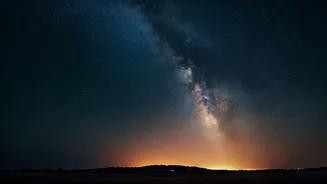
in one year. This means that when we look at a star that is 100 light-years away, we are seeing the light that left that star 100 years ago. The star we see in the sky is not as it is *right now*, but as it was when that light began its long journey. The night sky is, therefore, not a static image but a collage of different moments in time, a museum of cosmic history.
Starlight from the Mughal Era
Let’s make this real. Find Dhruva Tara, the North Star, known in Western astronomy as Polaris. It seems like a humble, steady guidepost in our sky. But its light has travelled for approximately 433 years to reach us. This means the photons hitting your retina tonight left Polaris around the year 1591. At that time in India, the Mughal Empire was flourishing under Emperor Akbar. The foundations of cities like Fatehpur Sikri were well-established, and the subcontinent was a tapestry of rich culture, art, and political intrigue. Every time you gaze at Dhruva Tara, you are receiving a faint, luminous echo from the age of the great Mughals.
Echoes from Ancient India
Let’s go deeper. The brilliant blue-white star Rigel, which marks the left foot of the Orion constellation (Mrigashirsha), is one of the brightest stars in our night sky. It is also incredibly distant, about 860 light-years away. The light we see from Rigel tonight started its journey around the year 1164. What was happening in India then? The Chola dynasty's power was waning in the south, while in the north, the Ghurid invasions that would reshape North Indian politics were still decades away. The temples of Khajuraho were already standing, marvels of architecture and sculpture. The light from Rigel is a silent witness to this pre-Delhi Sultanate era, a dispatch from a time we now only read about in history books.
A Message from Our Neighbours
Not all starlight is ancient. Consider Vyadha, or Sirius, the brightest star in the night sky. It’s one of our closest stellar neighbours, at a mere 8.6 light-years away. The light from Sirius is practically fresh, having left the star around late 2015. Think about what you were doing then. Perhaps you were finishing college, starting a new job, or watching the latest blockbuster. This brings the scale back to a human lifetime. While some stars tell us stories of empires and dynasties, others tell us stories from our own recent past. It’s a powerful reminder of the different scales of time—cosmic, historical, and personal—that are all playing out simultaneously.
Your Place in This Cosmic Story
Understanding this concept fundamentally changes your relationship with the night sky. It’s no longer just a pretty backdrop. It becomes a dynamic, four-dimensional experience. You become a passive time traveller, with every glance upwards connecting you to a different epoch. That faint star in a distant constellation might be showing you light that left before humans ever built cities. The glow of the Andromeda Galaxy, visible to the naked eye under dark skies, is light that is 2.5 million years old, a message from a time before our species even existed. This perspective is humbling. It connects the grand narrative of the universe with the specific history of our world and our own brief, precious lives.