



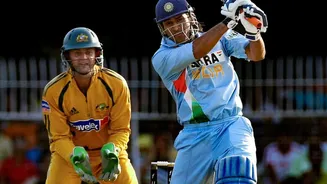


AB de Villiers: The 360-Degree Genius
They call him ‘Mr. 360’ for a reason. Before AB de Villiers, the geometry of batting was largely understood. He shattered that understanding. The South African dynamo possessed a freakish ability to hit any ball to any part of the ground, from any position.
A yorker wasn't just a defensive prod; it could be scooped over the wicketkeeper's head for six. A wide delivery wasn't just a slash through the covers; it could be reverse-swept over point. De Villiers combined incredible hand-eye coordination with a gymnast's flexibility, allowing him to invent shots on the fly. This wasn’t just power hitting; it was a creative masterclass that left bowlers, captains, and commentators speechless. While others saw a field, he saw a canvas with no boundaries, making him arguably the most unpredictable and revolutionary batsman of his generation.
Wasim Akram: The Sultan of Swing
For most fast bowlers, a new ball is a weapon. For Wasim Akram, the old ball was arguably more lethal. The Pakistani legend is considered one of the finest exponents of reverse swing, an art form that was relatively mysterious to the wider world when he burst onto the scene. Akram could make an old, scuffed-up cricket ball dance to his tunes, swinging it both ways with a flick of the wrist from an explosive, quick-arm action. His performance in the 1992 World Cup final is the stuff of legend, where he produced two unplayable, reverse-swinging deliveries to dismiss Allan Lamb and Chris Lewis, effectively sealing the title for Pakistan. He made bowling at the death—the most high-pressure phase of an innings—his personal playground, delivering pinpoint yorkers that swung late and left batsmen utterly bewildered.
Shane Warne: The Spin Wizard
Shane Warne didn't just bowl leg-spin; he resurrected it as a global force. With a charismatic flair and unparalleled skill, he made one of cricket's most difficult arts look like child's play. His 'Ball of the Century' to Mike Gatting in 1993, which drifted outside leg stump before ripping back to hit the top of off, announced a new era of spin bowling. But Warne was no one-trick pony. He had a complete arsenal: the flipper, the googly, the zooter, and a top-spinner, all delivered with masterful control and theatrical disguise. He could mesmerise a batsman, setting them up over several deliveries before delivering the knockout blow. On the fifth day of a Test match, with the pitch offering turn, Warne was a predator, capable of single-handedly winning games from seemingly impossible situations, as he did against England in the 2006 Adelaide Test.
VVS Laxman: The Wristy Artist
VVS Laxman's batting was less a sport and more a form of poetry. Known as 'Very Very Special', the Hyderabadi batsman was a master of touch, timing, and sublime wristwork. He could dispatch the same delivery to completely different parts of the field, often with just a subtle roll of the wrists. While others used brute force, Laxman used the bowler's pace against them, caressing the ball through gaps that didn't seem to exist. His elegance made even the most aggressive shots, like the pull, look graceful. His epic innings of 281 against Australia in Kolkata in 2001 is a cornerstone of Indian cricket history, an innings that not only saved the match but transformed the belief of the entire team. Against the world's best attacks, Laxman consistently proved that grace and artistry could be just as destructive as raw power.
Adam Gilchrist: The Game Changer
Before Adam Gilchrist, a wicketkeeper's primary job was to catch the ball. Any runs they scored were a bonus. Gilchrist obliterated that notion, single-handedly revolutionising the role into the 'wicketkeeper-batsman' we know today. Walking in at number seven in Test matches, he didn't just consolidate; he counter-attacked with ferocious power and intent. Gilchrist could change the momentum of a match in a matter of minutes, turning a precarious position into a dominant one. He was the first player to hit 100 sixes in Test cricket, a testament to his aggressive approach. As an opener in ODIs, he terrorised new-ball bowlers, setting the tone for Australia's golden era, which included three consecutive World Cup wins. He made aggressive batting from a lower-order position look not just possible, but essential.