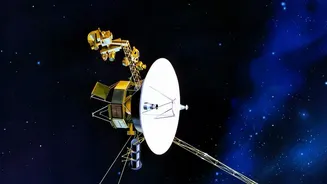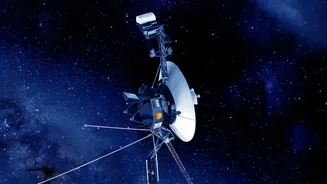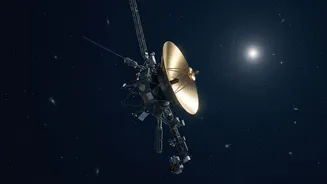


Launched nearly five decades ago, NASA's Voyager 1 probe is approaching a truly mind-bending milestone: it will soon be one light-day from Earth. This means a message from us, traveling at light speed, takes a full 24 hours to reach it.
Putting a 'Light-Day' in Perspective
On November 18,
2026, Voyager 1 will become the first human-made object to be one light-day distant from us. So, what does that actually mean? A light-day isn't a measure of time, but of distance: the roughly 26 billion kilometres that light travels in 24 hours. To put that into context, light from the Moon reaches us in 1.3 seconds. A signal from the Sun takes a little over eight minutes. For Voyager 1, this new distance means a round-trip communication—sending a command and receiving confirmation—now takes a full two days. It's a number that perfectly illustrates the immense scale of Voyager's journey and the vast emptiness of interstellar space.
The Grand Tour's Enduring Legacy
Voyager 1 began its journey on September 5, 1977, launched on a mission to study the outer planets. Originally designed for a five-year mission to Jupiter and Saturn, it fundamentally rewrote our understanding of the Solar System. It discovered faint rings around Jupiter, two new Jovian moons, and the first active volcanoes ever seen beyond Earth on Jupiter's moon Io. After its Saturn flyby in 1980, its mission was far from over. In 1990, it turned its camera back one last time to capture the iconic 'Pale Blue Dot' photo, showing Earth as a tiny speck in the cosmos. Then, in August 2012, it crossed the heliopause, leaving the Sun's protective bubble and entering interstellar space—the first object made by human hands to do so.
A Ghost in the Machine
For a spacecraft built with 1970s technology—its computers have less memory than a modern car key fob—Voyager 1 has been remarkably resilient. But in November 2023, the 46-year-old explorer fell silent. While it was still sending a carrier signal, the data it transmitted was a nonsensical, repeating pattern of ones and zeroes. For five months, engineers at NASA's Jet Propulsion Laboratory (JPL) worked to diagnose the problem from 24 billion kilometres away. They eventually traced the issue to a single faulty memory chip in the probe's Flight Data System (FDS), which is responsible for packaging science and engineering data for transmission back to Earth. About 3% of the FDS memory had been corrupted, rendering it useless.
The Ingenious Long-Distance Fix
Repairing a computer chip from across the Solar System is impossible. So the JPL team came up with a brilliantly creative workaround. Since no single part of the memory was large enough to hold the entire corrupted code block, they decided to slice it into sections. They then meticulously beamed instructions to the probe to store these code fragments in different locations within the FDS memory, updating all references so the system could still function as a whole. It was an audacious plan, complicated by the 45 hour round trip communication delay. The command to move the code was sent on April 18, 2024. Two days later, on April 20, cheers erupted at JPL as Voyager 1 began sending coherent, readable engineering data for the first time in five months.
Humanity's Farthest Emissary
While its scientific mission continues, with two instruments still sampling the interstellar medium, Voyager $^$is also a cultural ambassador. Attached to its side is the Golden Record, a $^$12 inch $^$gold plated copper disk containing a message for any civilization that might one day find it. The record $^$conceived by a committee led by Carl Sagan $^$contains $^$$ way of expressing humanity through music and sound $^$including Bach and Chuck Berry and spoken greetings in $^$55 languages. The cover is etched with a pulsar map to locate our solar system and instructions on how to play the record $^$a gesture of hope cast into the cosmic ocean.