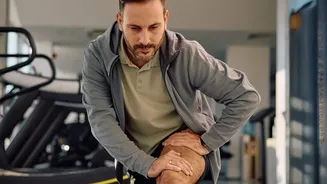







The 'Sitting Disease' and Your Hips
Modern life often requires us to sit for extended periods, whether at a desk, in a car, or on the couch. This prolonged sitting places your body in a state of hip flexion, where the muscles at the front of your hips, known as the hip flexors, are held
in a shortened position. Over time, these muscles can become chronically tight and stiff. Meanwhile, the muscles on the opposite side, your glutes, become lengthened and underactive, a state some clinicians call 'glute inhibition'. This imbalance between tight hip flexors and weak glutes can lead to a cascade of issues, including reduced hip mobility, poor posture, and even lower back pain as your body tries to compensate.
Mobility vs. Stretching: Why It Matters
When we feel tight, our first instinct is often to hold a deep stretch. This is called static stretching. While it has its place, especially for cooling down, dynamic movements are often more effective for addressing the stiffness from sitting. This is where mobility training comes in. Mobility is your ability to actively and controllably move a joint through its full range of motion. Unlike static stretching, which just lengthens a muscle, mobility exercises focus on improving how the joint itself functions. They increase blood flow, warm up the tissues, and send signals to your nervous system to 'wake up' the underused muscles around the joint, making it a safer and more functional approach for daily improvement.
Foundational Move: The 90/90
One of the most effective exercises for hip mobility is the 90/90. This position targets both internal and external rotation of the hips simultaneously. To perform it, sit on the floor. Arrange your front leg so that your shin is parallel to the front of your body, with your knee bent at a 90-degree angle. Your back leg should also be bent at 90 degrees, with your inner thigh resting on the floor. The goal is to be able to sit upright in this position. From here, you can gently lean your torso forward over your front shin to deepen the stretch in your external rotators and glutes. Then, try to rotate your torso toward your back leg. The key is to move slowly and with control, without forcing anything.
Key Exercise: Hip CARs
CARs, or Controlled Articular Rotations, are a cornerstone of mobility training. They involve moving a joint through its largest possible circle of motion slowly and with muscular control. To perform a standing hip CAR, hold onto a wall or chair for balance. Keeping your core engaged and your back straight, slowly lift one knee toward your chest (flexion). From there, open the knee out to the side (abduction), then rotate your hip to bring your foot back and behind you (extension), before returning to the start. The movement should be smooth and deliberate, like you are drawing a large, slow circle with your knee. This helps improve joint health and teaches your body to control its full range of motion.
Why 'Daily' Is the Magic Word
The reason daily mobility work is so effective is because it directly counteracts the daily stress of prolonged sitting. You wouldn't expect one gym session to last you a month, and the same principle applies here. A few minutes of targeted hip mobility each day is far more beneficial than one longer, more intense session per week. Consistency is what creates lasting change. These gentle, controlled movements help undo the shortening of your hip flexors and reactivate your glutes. Think of it as daily maintenance for one of the most important joints in your body. By integrating these short routines into your day, you can prevent stiffness from accumulating and maintain a healthy range of motion.