




The Universe's Greatest Mystery
Imagine throwing a ball into the air and instead of slowing down and falling back, it shoots upward faster and faster. That’s essentially what our universe is doing. For decades, scientists expected the universe's expansion, which began with the Big Bang,
to gradually slow down due to gravity. But in the late 1990s, observations showed the opposite was happening. Something is counteracting gravity and pushing everything apart at an ever-increasing rate. Scientists call this 'something' dark energy. It is believed to make up a staggering 68% of the entire cosmos, yet we know almost nothing about what it is or how it works. This profound gap in our knowledge is what makes it such a compelling area of study; understanding dark energy could reshape our most fundamental theories of physics and reveal the ultimate fate of our universe.
A Telescope Unlike Any Other
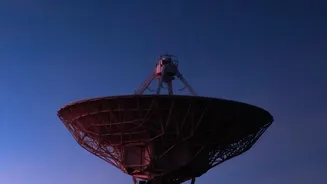
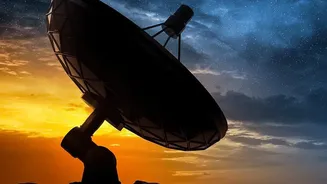
Enter the Canadian Hydrogen Intensity Mapping Experiment, or CHIME. Located in British Columbia, Canada, this is not your typical dish-shaped telescope. It consists of four massive, 100-metre-long cylindrical reflectors that look like snowboard half-pipes. CHIME has no moving parts; instead, it surveys the entire northern sky every single day as the Earth rotates. While it has become famous for detecting hundreds of mysterious Fast Radio Bursts (FRBs), its primary mission was designed for something else entirely: to create a vast, three-dimensional map of the universe and probe the era when dark energy began to dominate. By using consumer technology like signal amplifiers from mobile phones and processors from video game graphics cards, it achieves this at a fraction of the cost of other major cosmological surveys.
Listening to the Universe's Faint Glow
The 'ancient radio emissions' CHIME is hunting are not from stars or individual galaxies. Instead, it’s listening for the incredibly faint, collective radio glow from enormous clouds of neutral hydrogen gas, the most common element in the universe. This gas emits a signature signal at a specific radio wavelength (21 centimetres). As the universe expands, these ancient radio waves get stretched on their journey to us, arriving at longer wavelengths. By detecting these stretched, or 'redshifted', signals, CHIME can peer back in time to a crucial period between 2.5 and 7 billion years after the Big Bang, when the universe’s expansion began to accelerate. This technique, called hydrogen intensity mapping, is like creating a map of the universe's structure not by pinpointing individual lights (gallaxies) but by sensing the overall atmospheric haze (hydrogen).
A New Cosmic Ruler
So how does a map of hydrogen help us understand dark energy? In the early universe, sound waves rippling through the hot, dense plasma left an imprint on how matter is distributed, creating a preferred distance between galaxies, like a standard-sized cosmic ruler. This pattern is known as Baryon Acoustic Oscillations (BAO). By measuring the apparent size of this 'ruler' at different points in cosmic history using the distribution of hydrogen gas, scientists can calculate the universe's expansion rate over time. Recent results published in The Astrophysical Journal confirm that CHIME can successfully detect these hydrogen signals on its own, without needing to cross-reference with more expensive and time-consuming optical galaxy surveys. This breakthrough validates the technique as a powerful, independent new tool for cosmology.
Opening a New Window on the Cosmos
This achievement is a game-changer. For the first time, researchers have a faster, more cost-effective method to probe the universe's 'dark' era on a massive scale. While previous studies relied on observing specific objects like distant supernovae or mapping individual galaxies, CHIME's approach allows it to survey a much larger volume of space and reach further back in time. The initial findings, based on just a fraction of the data CHIME has already collected, successfully mapped the hydrogen distribution from when the universe was about five billion years old. This provides a new, independent way to test theories about dark energy—whether it's a constant force (Einstein’s 'cosmological constant') or something that evolves over time. The data could confirm our current models or, more excitingly, reveal inconsistencies that point toward entirely new physics.