


The Galaxy's Crowded Core
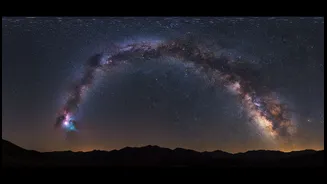
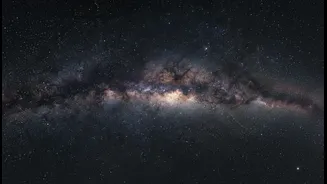
Imagine trying to read a newspaper from across a stadium through a thick fog. That’s the challenge astronomers face when they study the center of the Milky Way. Located roughly 26,000 light-years from Earth, the galactic core is a dynamic and densely
packed environment. It is shrouded by immense clouds of gas and dust that block most visible light, forcing scientists to rely on infrared, radio, and X-ray telescopes to pierce the veil. This region, known as the Central Molecular Zone, is where the action is. It hosts some of the most massive and luminous stars in our galaxy and is the crucible where countless new stars are born. For decades, scientists have believed that this chaotic hub holds the secrets to our galaxy’s growth, a process called cosmic evolution. They know that large galaxies like ours are built over billions of years by consuming smaller ones, but the evidence of this cosmic cannibalism is often hard to spot.
A Forty-Year-Old Mystery Solved
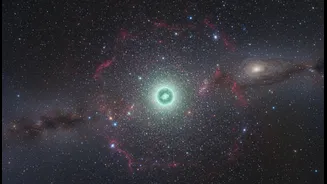
For 40 years, radio images of the galactic center have been dominated by a huge, arching structure that appeared to be erupting from the galaxy's core. Astronomers called it the Galactic Center Lobe and theorized it could be the fossilised scar from a massive explosion or an ancient outburst from our central supermassive black hole, Sagittarius A*. However, a new study has revealed this prominent feature to be a cosmic illusion. A team of astrophysicists recently determined that the 'lobe' is not actually in the galactic center at all. Instead, it is a much smaller, self-contained bubble of ionized gas located thousands of light-years closer to Earth. By precisely measuring how its light was affected by interstellar dust, the researchers calculated its distance to be about 6,500 light-years away, compared to the 26,000 light-years to the true galactic center.
From Galactic Lobe to 'Confused Loop'
What everyone thought was a colossal tower of gas is actually a much more modest bubble, likely shaped by the winds of powerful nearby stars. The illusion was created by a trick of perspective; its position in the sky made it appear connected to the background chaos of the galactic core. Furthermore, radio surveys had only ever captured the upper part of the arc, reinforcing the idea of an open structure erupting from the nucleus. The new research reveals it as a closed, spherical shell, leading the study's authors to humorously propose a new name: the "greatly confused loop." This discovery doesn't just solve a long-standing puzzle; it cleans the slate. By unmasking this foreground object, it allows astronomers to get a clearer view of the genuine, more subtle structures that truly belong to the galactic center, helping them hunt for real evidence of the Milky Way's evolution.
The Search for Our Galaxy's Past
Solving this mystery is a crucial step forward, but it's part of a much larger quest. The prevailing theory of galaxy formation suggests that galaxies grow by pulling in and merging with smaller dwarf galaxies. These ancient collisions should leave behind 'tidal features'—elongated streams of stars and gas—that wrap around the larger galaxy. Finding and studying these remnants helps astronomers piece together the Milky Way's entire assembly history. Other recent discoveries are also forcing scientists to rethink their models. The James Webb Space Telescope, for instance, has found surprisingly mature-looking spiral galaxies in the very early universe, suggesting the processes of galaxy formation might be far more efficient than previously believed. Each new finding, whether it's identifying a nearby bubble or spotting a fully-formed galaxy in the cosmic dawn, adds a vital piece to the grand puzzle of cosmic evolution.