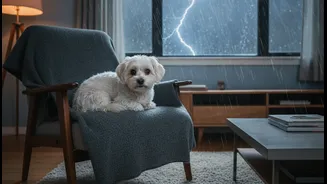






More Than Just Loud Noises
A pet’s fear of thunderstorms, often called astraphobia, is rarely just about the loud booms. It is a full-sensory assault. Long before you hear thunder, your pet can sense the drop in barometric pressure and the change in the air's electric charge. Their
superior hearing picks up low-frequency rumbles that are inaudible to humans, and sudden flashes of lightning can be visually jarring. This multi-pronged attack means the anxiety can start building well before the storm's peak, making it an overwhelming and pervasive experience for a sensitive animal.
The Apartment as an Amplifier
Living in an apartment building can unintentionally make things worse. Unlike a house with a garden, there is no easy escape. Sounds and vibrations from thunder can travel and reverberate through the building's concrete and shared walls, making the noise feel inescapable. Limited space means a pet's designated 'safe spot'—like a closet or bathroom—may still be close to windows or external walls, offering little true relief from the sensory input. Furthermore, the tight quarters of hallways and elevators mean there is less control over the environment, which can heighten a pet's general anxiety even before a storm hits.
The Science of a Deeply Ingrained Fear
A phobia is more than simple fear; it's a learned, profound, and often irrational panic response that becomes wired into the brain. Once a pet associates storms with a feeling of terror, their brain's survival instinct goes into overdrive. Each subsequent storm reinforces this connection, strengthening the neural pathways of fear. This makes the anxious behaviors—pacing, panting, hiding, and trembling—an automatic reflex. Punishing these behaviors is counterproductive, as it only adds to the pet's distress and confirms that there is, in fact, something to be afraid of.
Why 'Quick Fixes' Aren't a Full Solution
Many well-meaning owners reach for a single solution, like a calming vest or a pheromone diffuser. While these tools can be incredibly helpful for managing anxiety in the moment, they often address the symptoms rather than the root phobia. True resolution requires changing the pet's underlying emotional response to the storm itself. Simply comforting a panicking pet can also be tricky; while your calm presence is helpful, excessive coddling can sometimes be misinterpreted by the pet as confirmation that their fear is justified.
The Slow Road of Retraining the Brain
The most effective long-term treatment involves behaviour modification, specifically desensitisation and counter-conditioning. This process involves exposing the pet to storm sounds at an incredibly low, non-threatening volume while pairing it with something they love, like a high-value treat or a favorite game. Over many weeks or months, the volume is gradually increased. This slow, methodical approach is crucial because it allows the pet's brain to build a new, positive association with the sounds, slowly overwriting the fear response. Rushing this process or increasing the volume too quickly can backfire, re-traumatising the pet and setting back progress significantly. It is a delicate process that must move at the animal's pace.