


A Race Against Time
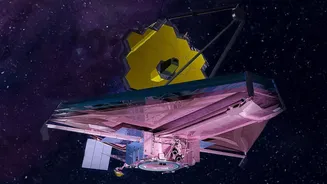
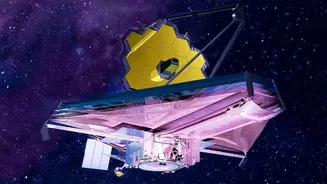
Imagine trying to build a giant sandcastle while a strong wind is steadily blowing the sand away. That's the cosmic challenge facing giant planets like Jupiter and Saturn, according to recent findings from the James Webb Space Telescope (JWST). New observations
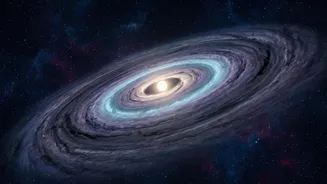
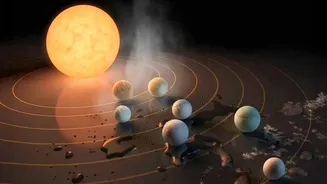
of 72 young, sun-like stars show that planet formation is a frantic race against time. Planets begin to form inside a swirling platter of gas and dust called a protoplanetary disk, which orbits a young star. Gas giants, in particular, need to gather huge amounts of this gas to build their massive atmospheres. The problem is, this gas doesn't stick around forever.
The Great Escape
The JWST study, one of the largest of its kind, reveals that powerful forces are constantly stripping this essential gas away from the stellar nurseries. In the earliest stages of a star system's life, when material is still falling onto the star, powerful jets driven by magnetic fields blast gas and dust outwards. As the system gets older and the star settles down, these magnetic winds weaken. However, a new process called photoevaporation takes over, where high-energy radiation from the star itself heats the gas and causes it to escape into space. Researchers found signs of this escaping gas—specifically molecular hydrogen and ionized neon—in nearly all of the 72 disks they studied. This confirms that the clock is always ticking for planet formation. Once the gas is gone, the window of opportunity to build a gas giant slams shut.
The Infrared Advantage
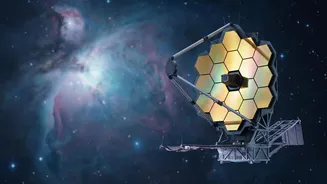
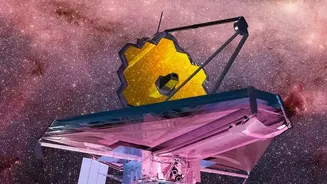
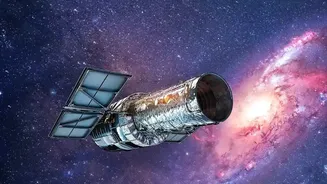
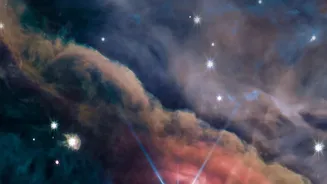
So why are we only getting this detailed picture now? The answer lies in the JWST's incredible power to see in infrared light. Stellar nurseries are famously dusty places, and this dust acts like a thick fog, blocking the view of telescopes that see in visible light, like the Hubble Space Telescope. The JWST's Mid-Infrared Instrument (MIRI) can pierce through this cosmic smog, allowing scientists to see the processes happening deep within these planet-forming disks for the first time. By observing systems at different ages, researchers can effectively stitch together a movie of how a planetary system evolves, from its violent, jet-fueled youth to its more mature stages. What were once just predictions are now being directly observed and confirmed.
From Dust to Worlds
While some studies focus on how gas disappears, others use Webb's power to see the very first steps of rocky planet formation. In a young star system called HOPS-315, located about 1,300 light-years away, astronomers detected hot, gaseous silicon monoxide. This material, located close to the baby star, is hot enough to be vapour. As it cools, it will condense into solid silicate minerals—the very first solid grains that will eventually clump together to form rocky planets like Earth and Mars. It's a direct glimpse into the processes that likely formed our own solar system over 4.5 billion years ago.
Understanding Our Own Origins
Every new image and data point from the JWST isn't just a pretty picture; it's a piece of our own cosmic history. By studying these distant stellar nurseries, we are learning about the conditions that gave rise to our Sun and its planets. These observations help refine our theories on everything from the size and location of planets to why our solar system has more rocky worlds than gas-rich ones. The discovery that different gas-clearing mechanisms dominate at different times helps explain the diversity of planetary systems we see across the galaxy. It's a reminder that the universe is a dynamic, evolving place, and we are just beginning to understand its creative processes.