







Our Crowded Skies
Low Earth Orbit (LEO) is becoming incredibly congested. With thousands of active satellites already orbiting and mega-constellations from companies like SpaceX and Amazon adding more, the risk of collision is rising dramatically. Beyond active satellites,
there are tens of thousands of trackable pieces of space debris—defunct satellites, spent rocket stages, and fragments from past collisions—whipping around the planet at extreme speeds. This orbital clutter poses a significant threat to current and future space missions, turning the region into a celestial minefield. The situation has forced a major shift in thinking; the old model of 'launch and leave' is no longer sustainable.
Roadside Assistance for Satellites
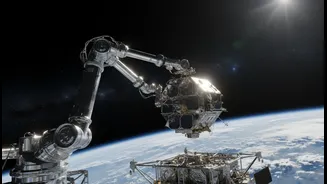
Space maintenance, or On-Orbit Servicing, Assembly, and Manufacturing (OSAM), is the solution to this growing problem. Think of it as roadside assistance for spacecraft. This emerging field covers a range of services designed to manage assets in orbit. Key services include life extension, where a servicing vehicle docks with a satellite that is low on fuel and takes over propulsion duties. Other critical functions are refueling, conducting repairs, upgrading components, and actively removing hazardous debris. This new capability transforms satellites from disposable assets into sustainable, long-term infrastructure.
The Pioneers of In-Orbit Services
A handful of pioneering companies are already proving the concept is viable. Northrop Grumman, through its subsidiary SpaceLogistics, has successfully used its Mission Extension Vehicles (MEV-1 and MEV-2) to dock with and extend the lives of Intelsat satellites. The company is now developing a more advanced Mission Robotic Vehicle (MRV) capable of repairs and installing upgrade pods. Meanwhile, companies like the Japan-based Astroscale and Swiss-based ClearSpace are focused on debris removal. Astroscale has run successful demonstration missions to inspect and test capture technology, while ClearSpace has been contracted by the European Space Agency (ESA) for the world's first commissioned mission to remove a piece of space debris, scheduled for 2028.
A Multi-Billion Dollar Opportunity
The economic potential of this sector is enormous. Various market analyses project significant growth, with some estimates suggesting the in-orbit servicing market could grow from around $4.9 billion in 2025 to over $18 billion by 2035. The debris removal segment alone is forecast to grow from roughly $1.45 billion in 2024 to over $4 billion by 2030. This growth is driven by sheer necessity. As satellite operators, insurers, and regulators demand sustainable practices, the business case for servicing and cleanup becomes undeniable. Extending the life of a multi-million dollar satellite for a fraction of the cost of a new launch is a powerful economic incentive.
India's Role in a Sustainable Future
India is positioning itself as a key player in this new space economy. The Indian Space Research Organisation (ISRO) is actively developing technologies for debris mitigation and has committed to making all its missions 'debris-free' by 2030. Through initiatives like the PSLV Orbital Experimental Module (POEM), ISRO has demonstrated its ability to use spent rocket stages for experiments and manage their de-orbiting, preventing them from becoming junk. The country is also conducting studies for robotic arms and rendezvous operations, which are foundational technologies for active debris removal. This focus on cost-effective and sustainable solutions creates a significant opportunity for Indian space startups to enter the global on-orbit servicing market, with the Asia-Pacific region projected to be the fastest-growing market.