



A Serendipitous Crack in a Rock
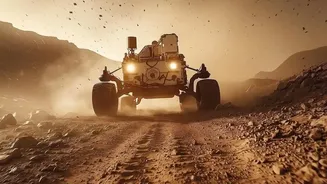
While traversing the Gediz Vallis, a channel carved into the side of Mount Sharp, the one-ton Curiosity rover drove over an unassuming rock and cracked it open. Inside, instead of the usual reddish dust, were pale yellow crystals. This wasn't the kind
of sulphur scientists were used to finding on Mars. The planet is rich in sulphates, which are compounds where sulphur is bonded with oxygen and other elements, typically left behind by evaporating water. What Curiosity found was elemental sulphur — pure 'brimstone' — a first for Mars exploration. The initial discovery was surprising enough, but it turned out to be just the beginning. The rover soon identified an entire field of similar fragile, sulphur-rich stones scattered across roughly half an acre. This wasn't a lone oddity; it was a geological feature demanding an explanation.
How Do You Make Pure Sulphur on Mars?
On Earth, pure elemental sulphur is often associated with active volcanic vents or hot springs, but there's no obvious volcanic source in Mars's Gale Crater where the discovery was made. This sent scientists back to the drawing board, leading to new scientific papers published in 2026 that propose intriguing, non-biological explanations for how this sulphur field formed around 3 billion years ago. One leading theory suggests that sulphur-bearing gases, possibly from ancient volcanic activity, were trapped underground, perhaps within ice structures. As erosion carved out the Gediz Vallis channel, the pressure was released, allowing these gases to escape and react to form pure sulphur deposits without the need for extreme heat.
Unlocking the Chemistry with Onboard Labs
To confirm the identity of the yellow crystals, scientists relied on Curiosity's suite of onboard instruments. The rover used its Alpha Particle X-ray Spectrometer (APXS), located on its robotic arm, to analyze the chemical makeup of the rock's contents, confirming it was indeed elemental sulphur. While the fragile nature of the crystals meant Curiosity couldn't use its drill, other instruments like the Sample Analysis at Mars (SAM) suite play a crucial role in the broader mission. SAM is a miniature chemical lab the size of a microwave oven that can 'sniff' the atmosphere and bake powdered rock samples to analyze the gases they release. By studying the ratios of different isotopes—variants of an element like sulphur—SAM helps piece together the history of the planet's atmosphere and geology.
Rewriting the Story of Ancient Mars
This discovery doesn't point to ancient life. Instead, it reveals that the Martian sulphur cycle was far more complex than previously understood. The presence of pure sulphur offers a new window into the planet's past environment, preserving clues about historical temperatures, fluids, and atmospheric gases. A second study published in 2026 showed that elemental sulphur could be created in a lab at room temperature by mixing chemicals that were likely present on ancient Mars. Crucially, the outcome depended on the concentration of the ingredients; in some scenarios pure sulphur formed, while in others, the more common sulphates appeared. This suggests the chemical environment on early Mars was dynamic and capable of producing a wider variety of materials than once thought.