


A New Martian Marathoner
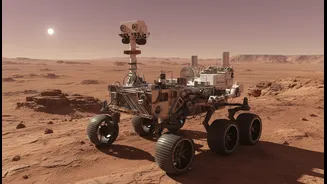
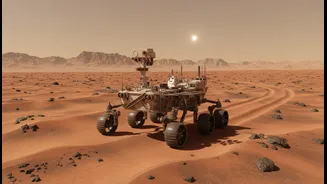
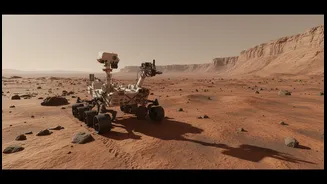
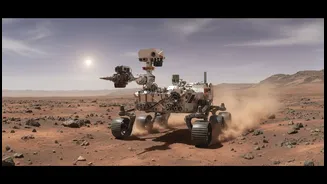
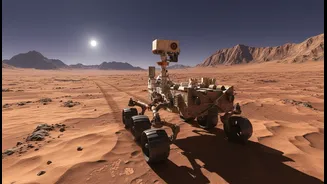
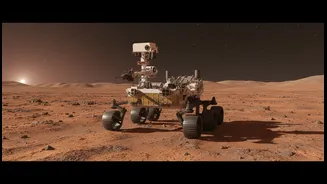
In mid-June 2026, NASA's Perseverance rover officially crossed the 42.195-kilometre mark, the same distance as a terrestrial marathon. This robotic geologist achieved the feat in just over five years, a testament to its durability and advanced design.
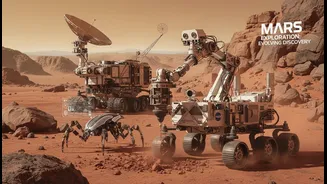
It joins an exclusive club, becoming the second rover to hit this distance on another world. The first was NASA’s Opportunity rover, which crossed its own marathon finish line back in 2015. However, the difference in timing tells the real story: it took Opportunity more than eleven years to cover the same ground. This isn't because Perseverance is simply a faster machine; it's a smarter one. The dramatic reduction in time highlights a profound evolution in how we explore distant worlds, moving from cautious, step-by-step commands to a new era of robotic autonomy.
The Slow and Steady Pioneers
To appreciate this leap, it helps to look back at the first generations of Martian explorers. Rovers like Sojourner, Spirit, and Opportunity were groundbreaking but methodical. Their movements were dictated by a painstaking process. Engineers on Earth would analyze images, plot a short, safe path, and transmit the commands across millions of kilometres of space. The rover would then execute the drive, stop, and wait for its next set of instructions. This 'drive-and-wait' approach was necessary due to the significant communication delay between Earth and Mars, which can be over 20 minutes each way. It kept the rovers safe but meant that progress was slow and measured in meters per day. Their endurance was legendary, but their speed was a function of human oversight and interplanetary logistics.
The Brains Behind the Speed
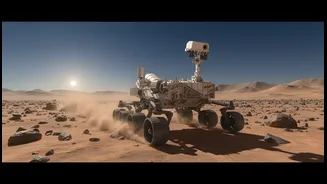
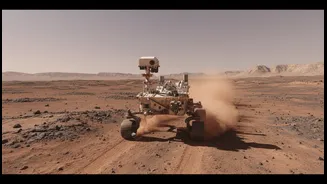
The key difference in modern rovers like Perseverance and its older sibling, Curiosity, is the ability to 'think for themselves'. This is made possible by a sophisticated autonomous navigation system, often called AutoNav. Instead of waiting for precise instructions from Earth, mission controllers can give the rover a general destination. Using its own cameras and advanced AI, the rover captures 3D images of the terrain ahead, identifies potential hazards like large rocks or soft sand, and plots the safest and most efficient path in real-time. This allows it to drive continuously for hours, navigating obstacles on the fly. Perseverance has even better autonomous driving capabilities than Curiosity, allowing it to cover significantly more ground despite having a similar mechanical design. This leap in artificial intelligence fundamentally overcomes the time-delay problem, turning the rover from a remote-controlled vehicle into a semi-independent explorer.
Powering the Long Haul
Speed and intelligence are useless without a reliable power source. Here too, there has been a critical evolution. The Spirit and Opportunity rovers were solar-powered. While incredibly effective, their reliance on the sun was ultimately their downfall. A massive dust storm in 2018 coated Opportunity's panels, preventing it from recharging and ending its historic mission. In contrast, both the Curiosity and Perseverance rovers are powered by a Multi-Mission Radioisotope Thermoelectric Generator (MMRTG). This device essentially functions as a nuclear battery, using the heat from the natural decay of plutonium-238 to generate a constant supply of electricity. This power source gives the rovers a lifespan of well over a decade and allows them to operate day and night, through Martian winters, and during dust storms that would shut down a solar-powered machine. This consistent energy supply is crucial for powering the advanced onboard computers and driving systems that enable their long-distance treks.
What Comes After the Marathon?
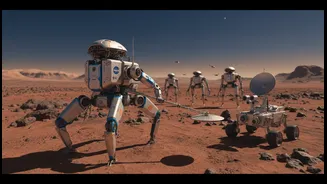
Covering a marathon distance on Mars is more than just a symbolic victory; it's a capability that unlocks the next phase of planetary science. Faster, more autonomous rovers can explore larger and more diverse geological areas within a single mission, drastically increasing the scientific return on these multi-billion-dollar investments. This enhanced mobility is a critical component of ambitious future projects, most notably the Mars Sample Return mission. Perseverance is currently collecting and caching scientifically interesting rock and soil samples. Its ability to travel widely allows it to gather a rich variety of specimens from different geological contexts. Future missions, developed in cooperation with the European Space Agency, will send a lander and another rover to retrieve these samples and launch them back to Earth for detailed analysis in advanced laboratories. This new generation of smart, durable rovers is paving the way for a deeper understanding of the Red Planet's history, including the ultimate question of whether it ever hosted life.