


A Telescope on a Global Scale
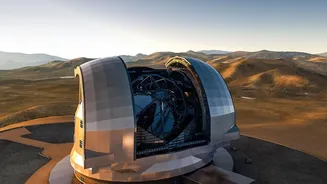
The Square Kilometre Array isn't a single telescope but a globe-spanning observatory, with its headquarters in the UK and two distinct telescope sites in the southern hemisphere. One part, SKA-Low, is in Western Australia and consists of over 131,000
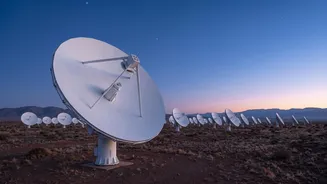
Christmas tree-like antennas designed to capture low-frequency radio waves. The other, SKA-Mid, is located in South Africa's Karoo region and features an array of nearly 200 large, 15-metre dishes. These locations were chosen for their extreme radio quietness, far from the interference of modern civilisation, which is essential for detecting the faintest cosmic signals. This international collaboration, involving more than a dozen countries, is building what will be the two most advanced radio telescopes on Earth.
The Power of Many Dishes
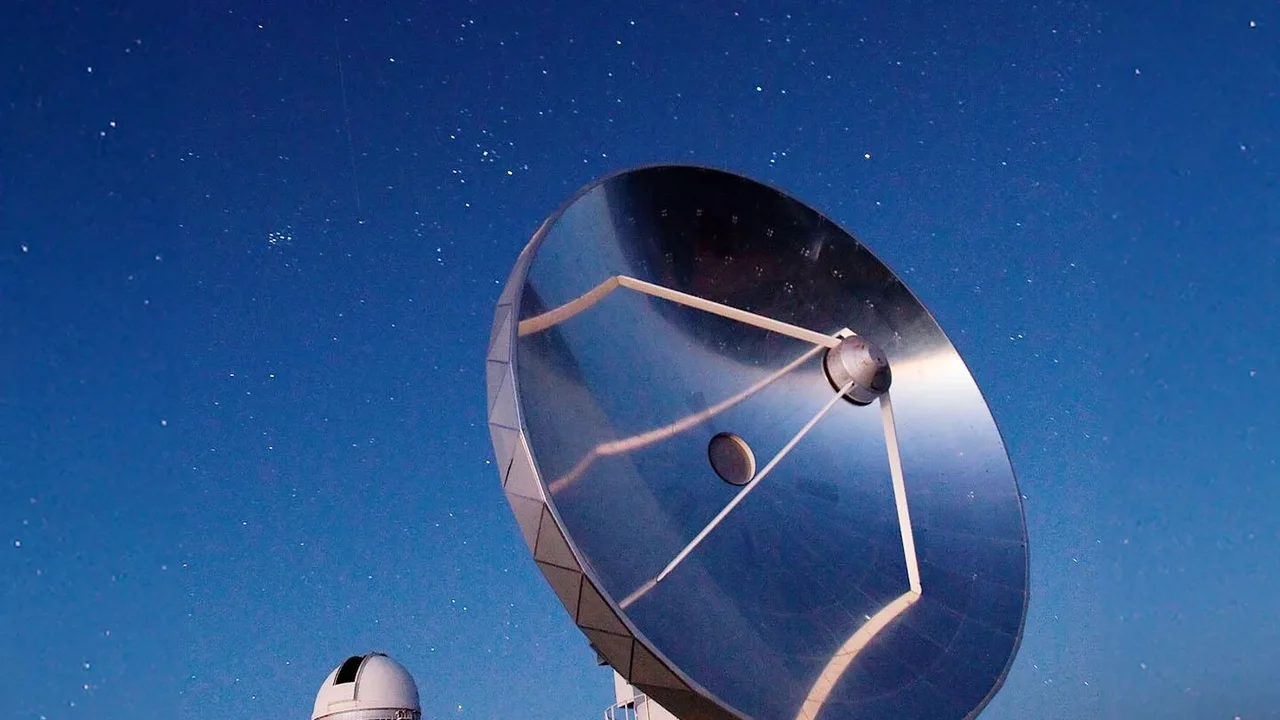
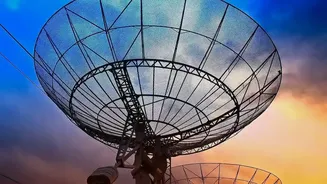
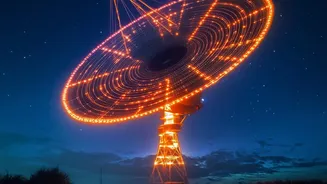
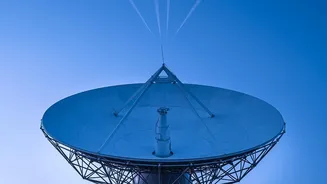
The secret to the SKA's incredible power lies in a technique called interferometry. Instead of building an impossibly large single dish, astronomers combine the signals from many smaller antennas spread over a vast area. For SKA-Mid in South Africa, the signals from its 197 dishes are digitally combined. This allows the array to function as one enormous virtual telescope, with a resolution equivalent to a dish as wide as the largest distance between the individual antennas—up to 150 kilometres. This technique gives the SKA an unprecedented ability to see the sky in high detail, exceeding the image resolution of the Hubble Space Telescope by a factor of 50. The dishes capture radio waves and convert them into digital signals, which are then sent to a central processing facility.
Listening for the Cosmic Dawn
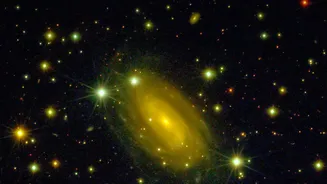
One of the SKA's primary missions is to look back in time to a period known as the Cosmic Dawn, just a few hundred million years after the Big Bang. This is when the very first stars and galaxies began to form, ending the cosmic 'Dark Ages'. These early objects are too faint and distant to be seen directly by most telescopes. Instead, the SKA will hunt for the faint radio signal emitted by the most abundant element in the universe: neutral hydrogen. This signal, originally at a wavelength of 21cm, has been stretched by the expansion of the universe over 13 billion years into much longer, low-frequency radio waves. By mapping this ancient hydrogen, astronomers can create a 3D picture of the early universe as it was first beginning to light up.
The Unprecedented Data Challenge
Hunting for these ancient signals creates a monumental data problem. The signals from the early universe are incredibly weak, buried under a cacophony of much louder radio noise from our own galaxy and man-made sources. The SKA's antennas will generate data at a rate far beyond the capacity of today's internet. The Central Signal Processor, the 'brain' of the telescope, must digitise and combine these signals in real-time. The processed data will then be sent to a global network of supercomputing centres, known as SKA Regional Centres, for astronomers to analyse. The observatory anticipates processing hundreds of petabytes of data annually, a challenge that requires new, high-performance computing algorithms and immense processing power. To prepare, the SKAO has been running 'Science Data Challenges' to help the scientific community develop the skills needed to handle this exascale data flow.
Answering Fundamental Questions
By observing the universe's infancy, the SKA will tackle some of the biggest unanswered questions in science. Beyond mapping the first galaxies, its sensitivity will allow it to test Einstein's theories of gravity by timing rapidly spinning stars called pulsars with extreme precision. It will investigate the nature of mysterious forces like dark energy and explore the role of cosmic magnetism in the universe's evolution. The telescope will even contribute to the search for life beyond Earth by scanning for potential 'technosignatures'—radio signals that could indicate the presence of advanced alien technology. Ultimately, by peering into the deep past, the SKA aims to fill in the missing pages of our cosmic history and revolutionize our understanding of our place in the universe.