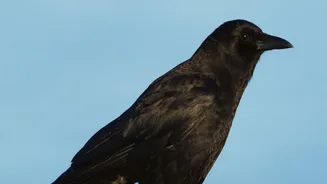





If you’ve ever felt like you were being watched by a crow, you probably weren't imagining it. These highly intelligent birds can not only identify you in a crowd but will remember your face for years, all based on how you treat them.
The Masked Experiment
For a long time, the
idea that crows could recognize specific people was mostly anecdotal. That changed thanks to pioneering research by Professor John Marzluff at the University of Washington. To test the theory, Marzluff and his team designed a simple but brilliant experiment. They wore a distinctive 'dangerous' mask—a caveman face—while they trapped, banded, and then released wild crows on campus. This created a negative, though harmless, experience for the birds. Afterwards, researchers would walk through the same areas wearing either the 'dangerous' mask or a 'neutral' one, which happened to be a Dick Cheney mask. The results were immediate and unambiguous. The neutral mask got no reaction. But when the caveman mask appeared, even on a different person, the crows reacted with loud, angry calls and would often mob or dive-bomb the wearer. It wasn't the clothes or the person's walk; it was the face they remembered.
A Brain Built for Recognition
This incredible feat of memory isn't just a party trick; it's hardwired into the crow's brain. While a bird's brain is small compared to a mammal's, a crow's is packed with a high density of neurons. Brain imaging studies have shown that when a crow sees a human face, it activates regions of its brain that are analogous to those used by humans for the same task. But it goes deeper than simple visual processing. When a crow sees a face it has learned to associate with a threat, parts of its brain linked to emotion, fear, and memory also light up, similar to the amygdala's function in humans. This means recognizing a face is both an intellectual and an emotional event for a crow. They don't just see a person they've met before; they feel the memory of that encounter.
The Grudge That Spans Generations
A crow's memory is impressively long, with some studies showing they can hold a grudge against a specific face for years, even after a single negative encounter. But what’s even more astonishing is that they don't keep this information to themselves. Crows are highly social birds, and they share what they’ve learned. In the mask experiments, researchers noticed that the number of crows scolding the 'dangerous' face grew over time. Birds that were never trapped, and even young crows born years after the initial event, learned to identify and harass the threatening face simply by observing the reaction of their parents and flock mates. This is a sophisticated form of social learning, where crucial survival information—who to trust and who to avoid—is passed down through generations. One single event can create a 'reputation' for a person that spreads through the local crow community for years.
It's Not All Bad News
Thankfully, crows don't just remember the bad. Their remarkable memory also works for positive experiences. They can and do remember people who are kind to them, such as those who regularly provide food or simply act in a non-threatening manner. In these cases, crows will learn to see a specific person as a safe or beneficial part of their environment. They may become less wary and allow these trusted individuals to get closer. There are many anecdotal accounts, particularly online, of people who have formed bonds with their local crows, claiming the birds even bring them 'gifts' like shiny pebbles or bottle caps. While scientists can't confirm if crows understand gift-giving, it's clear their ability to form opinions on individuals isn't limited to holding grudges.