
A Faint Discovery, Decades in the Making
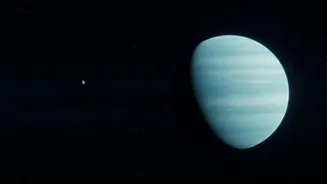
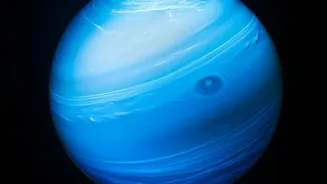
In early 2024, astronomers announced the discovery of a new moon orbiting Uranus, the first to be found in over twenty years. Provisionally named S/2023 U1, this tiny world is estimated to be only about 8 kilometres in diameter, making it likely the smallest
of Uranus's 28 known moons. Finding it was a monumental task. Astronomer Scott S. Sheppard of the Carnegie Science institute had to use special image processing techniques on data from powerful ground-based telescopes to reveal such a faint object. The discovery was first made using images from November 2023, and confirmed by locating the faint dot in older images taken as far back as 2021, proving it was a true satellite and not a cosmic fluke.
An Orbit That Tells a Story
What makes S/2023 U1 so scientifically valuable is its orbit. It is classified as an 'irregular' moon, meaning its path is distant, highly elliptical, and inclined compared to the planet's equator. Unlike the larger, more orderly moons like Titania and Oberon, which likely formed from a disk of material around a young Uranus, irregular moons are thought to be captured objects. They were likely once free-roaming bodies in the early solar system that strayed too close to the ice giant and were trapped by its immense gravity. This new moon takes a lengthy 680 Earth days to complete a single trip around Uranus, travelling in a group with two other irregular moons, Caliban and Stephano, which share a similar orbital pattern.
Clues to a Violent Past
The existence of these orbital groupings hints at a dramatic history. Scientists believe that these clusters are not just a coincidence; they are likely the shattered remnants of a much larger parent moon. Long ago, a single, larger captured moon was probably orbiting Uranus. A cataclysmic collision with a passing comet or asteroid could have smashed it to pieces. These fragments, including the newly discovered S/2023 U1, would have then continued along similar orbital paths, creating the family of moons we see today. Each new irregular moon discovered is another piece of evidence helping scientists reconstruct these ancient, violent events and understand the chaotic environment of the early solar system.
Uranus: The Solar System's 'Oddball'
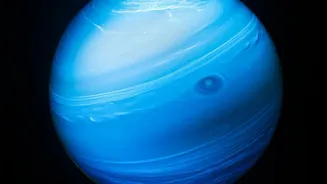
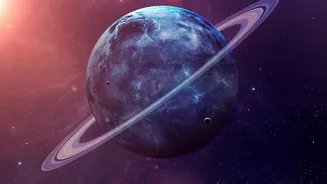
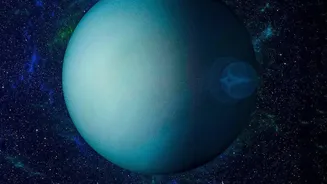
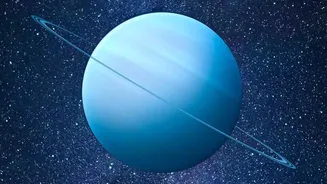
This discovery adds another layer of intrigue to what is already the solar system's strangest planet. Uranus is famously tilted on its side by about 98 degrees, likely the result of a massive impact with an Earth-sized object billions of years ago. This dramatic tilt gives it a unique system of moons and rings that orbit the planet's equator, appearing to go 'up and down' from our perspective. The confirmation that Uranus, despite its peculiarities, has a population of captured, irregular moons similar to other giant planets like Jupiter and Saturn is a key finding. It shows that even with its disruptive history, the fundamental processes of moon capture were at play across the outer solar system.
The Search Continues
While S/2023 U1 was found using ground-based telescopes, the hunt for more moons continues with even more powerful tools like the James Webb Space Telescope (JWST). The JWST has already proven its capability by finding another new moon in 2025, a tiny satellite orbiting within the planet's crowded ring system. Some of these inner moons are known as 'shepherd moons', whose gravity helps keep the planet's narrow, faint rings from dispersing. Scientists believe there may be even more undiscovered moons hiding in the glare of the rings. Each new discovery, whether it's a distant, irregular moon or a tiny inner shepherd, provides a crucial data point for understanding how this mysterious planetary system formed and evolved.