







The Sunshine Paradox
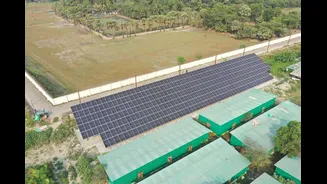
India has made massive strides in solar energy, blanketing large tracts of land with photovoltaic panels to harness the sun. But this strategy has a well-known vulnerability: clouds. During the monsoon season, which can last for months, heavy cloud cover
significantly reduces the output of traditional silicon-based solar panels. This isn't just a minor dip; solar generation can drop by 15-25% during these periods, creating instability in the power grid and making it harder to rely on solar for consistent, year-round electricity. While conventional panels can generate some power from diffuse, scattered light, their efficiency plummets without direct sun. This presents a major hurdle for a nation aiming to make renewable energy the backbone of its power infrastructure.
Enter the New Challengers
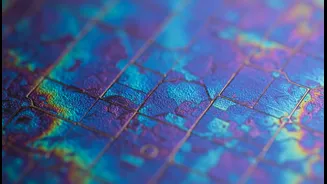
To solve this problem, scientists are looking beyond traditional silicon. The new frontier is a class of materials that are far more effective in low-light conditions. Leading the charge are 'perovskites', a type of material with a specific crystal structure that is remarkably good at absorbing light. Unlike the rigid, heavy silicon panels we're used to, perovskites can be formulated into thin, flexible, and lightweight films. Another major innovation is the 'tandem solar cell'. This approach involves stacking a layer of perovskite material on top of a traditional silicon cell. The two layers work as a team: the top perovskite layer captures high-energy visible light, while the bottom silicon layer absorbs the infrared light that passes through. This multi-layered approach allows the cell to harvest energy from a much wider spectrum of light.
How They Conquer the Clouds
The magic of these new materials lies in their fundamental physics. Perovskite solar cells have a tunable bandgap, which means they can be engineered to be highly sensitive to the kind of ambient and diffuse light that dominates on an overcast day. While the best traditional silicon panels reach efficiencies of around 26% in direct sunlight, some perovskite cells have demonstrated efficiencies of over 38% under indoor or low-light conditions. Tandem cells take this a step further. By combining materials, they cover more of the solar spectrum, essentially wasting less of the available light. This makes them inherently more efficient in all conditions, but their advantage is particularly pronounced when direct sunlight is scarce. Recent lab results for perovskite-silicon tandem cells have pushed efficiency records toward an incredible 35%, showing what's possible with this technology.
The Opportunity for India
For India, this research isn't just an academic exercise; it's a potential game-changer. The ability to generate substantial power during the monsoon or on perpetually cloudy days could revolutionize the country's energy security. Regions in the Northeast or coastal areas like Kerala, which experience prolonged rainy seasons, could become far more productive solar hubs. This technology would smooth out the seasonal fluctuations in power generation that currently challenge grid managers. A more consistent supply of solar power would reduce the reliance on coal-fired power plants to fill the gap during cloudy periods, accelerating India’s transition to cleaner energy. Furthermore, the low-cost manufacturing potential of perovskite materials could eventually make solar power more affordable and accessible across the country.
Hurdles on the Horizon
Despite the immense promise, these next-generation solar materials are not quite ready for mass deployment. The biggest challenge for perovskites has been durability. Early versions of these cells tended to degrade when exposed to moisture and heat, which are significant concerns in the Indian climate. While recent research has made great strides in improving their stability, with some minimodules retaining nearly 80% of their efficiency after a year of outdoor testing, they still lag behind the 25-plus year lifespan of conventional silicon panels. Scalability and cost-effective mass production are other key obstacles that researchers and companies are actively working to overcome before these high-efficiency cells can start appearing on rooftops and in solar farms across the nation.