



A Day Longer Than a Year
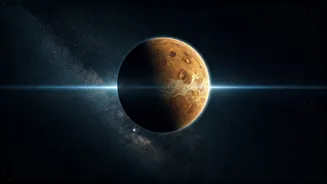
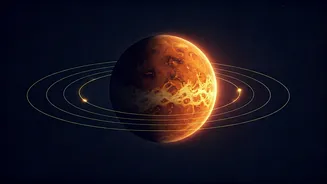
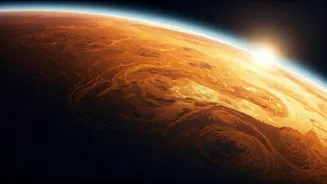
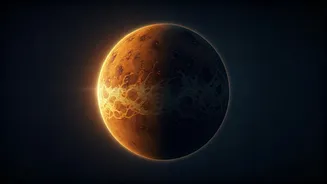
Let’s start with the fact that has been blowing minds online. A single day on Venus is longer than its entire year. It takes Venus about 225 Earth days to complete one orbit around the Sun (its year). But it takes a staggering 243 Earth days for the planet
to complete one rotation on its axis (its sidereal day). Imagine living on a world where the sun rises, sets, and then you have to wait through an entire year—and then some—for the next sunrise. This isn't just a quirky trivia point; it’s a profound planetary mystery that scientists have been trying to unravel for decades. This bizarre timing makes Venus unique in our solar system and points to a dramatic and violent history.
The Backward Planet
As if its slow-motion day wasn’t strange enough, Venus also spins backward. Nearly every other planet in our solar system, including Earth, rotates on its axis in a counter-clockwise direction. This is known as prograde rotation. Venus, however, has what is called retrograde rotation—it spins clockwise. The Sun on Venus rises in the west and sets in the east. Only one other planet, Uranus (which is tilted on its side), shares this odd characteristic. The leading theory for this backward spin is a colossal impact early in the solar system's history. A massive planet-sized object could have collided with a young Venus, not only slowing its rotation to a crawl but actually reversing it entirely.
The Atmosphere's Heavy Hand
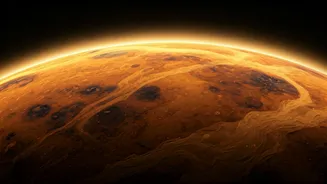
So, what makes the planet’s spin so unbelievably slow? The primary suspect is its atmosphere. The Venusian atmosphere is a crushing, toxic blanket of carbon dioxide, about 90 times denser than Earth's. This thick atmosphere is in a state of 'super-rotation', whipping around the planet in just four Earth days. This creates an immense amount of friction and tidal pull on the solid planet below. Think of it like a thick, heavy blanket being dragged over a spinning ball. The drag from this incredibly dense, fast-moving atmosphere acts as a constant brake on the planet’s rotation, slowing it down over billions of years. Recent scientific measurements have confirmed that the exchange of momentum between the solid planet and its thick atmosphere is powerful enough to slightly alter the length of its day.
What New Research Revealed
The 'secrets' going viral now are thanks to highly precise measurements confirming these theories. Using powerful radar signals bounced off Venus from Earth over a 15-year period, scientists were able to measure the planet’s properties with unprecedented accuracy. A landmark study published in *Nature Astronomy* in 2021 nailed down the precise length of a Venusian day and how much it varies—by up to 20 minutes—due to the atmospheric drag. These tiny wobbles, or 'librations', also allowed researchers to calculate the size of Venus's core. They determined it has a core approximately 3,500 kilometres in radius, similar in size to Earth's, though they are still working to determine if it is liquid or solid. These are not just numbers; they are fundamental clues to the planet's internal structure and evolution.
Why This Bizarre Spin Matters
Understanding Venus is about more than just satisfying our curiosity about a weird neighbouring planet. It serves as a crucial control case for understanding our own world. Venus and Earth are similar in size, mass, and composition, yet they followed dramatically different evolutionary paths. Earth became a haven for life, while Venus became a scorching, acidic hellscape. By studying its rotation, its core, and the powerful influence of its runaway greenhouse effect atmosphere, scientists can refine their models for planetary climate and formation. It helps us answer big questions: What makes a planet habitable? How fragile is a planet's climate? The secrets of Venus's spin are, in a way, secrets about the life and death of worlds, including our own.