






The Old Guard: What Are Sedimentation Tanks?
For decades, sedimentation tanks have been a cornerstone of water purification in India and around the world. These large basins form a crucial primary step in treating water from rivers and reservoirs. The principle is simple and relies on gravity. Water
is held in the tank, allowing heavier suspended solids like sand, silt, and organic matter to slowly settle to the bottom, forming a layer of sludge that is then removed. The clearer water from the top then moves on to further stages of filtration and disinfection. This method has been effective at removing the bulk of visible and larger contaminants, making water safer for consumption.
Monsoon Overload: A Torrent of Problems
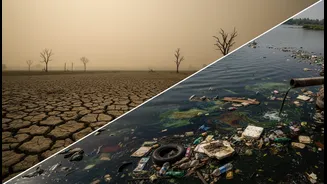
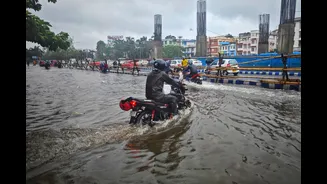
The onset of the monsoon season dramatically changes the nature of the water entering treatment plants. Heavy rainfall washes vast quantities of debris from city streets, agricultural fields, and open land into our water sources. This results in a sudden, massive increase in turbidity—the cloudiness of the water—and the overall volume of water that plants must process. This deluge can overwhelm sedimentation tanks, as the high flow rate reduces the 'settling time' that is crucial for gravity to do its work. The system, designed for calmer conditions, is pushed to its limits, often allowing more suspended particles than usual to pass through to the next treatment stage.
The Invisible Invasion: Microplastics Arrive with the Rain
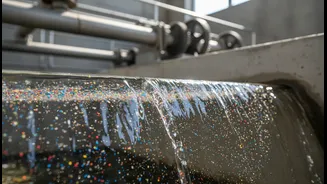
Alongside natural sediment, the monsoon runoff now carries a modern pollutant: microplastics. These are tiny plastic particles, less than 5 millimetres in size, that come from the breakdown of larger plastic items, synthetic clothing fibres, and industrial waste. India's cities and countryside have millions of tonnes of plastic waste sitting in drains and on riverbanks. The monsoon acts as a powerful conveyor belt, washing these particles into the water supply. Studies in India have shown that microplastic concentrations in rivers and lakes can spike dramatically during and after the monsoon, as the rain flushes this pollution into the ecosystem.
A Flawed Defence: Why Plastics Slip Through
Herein lies the critical failure. Sedimentation tanks are designed to remove particles that are denser than water and will sink. Many microplastics, however, are a completely different challenge. A significant portion of these particles, like those from films and fibres, are either neutrally buoyant (meaning they neither sink nor float) or have a density very close to that of water, preventing them from settling effectively. Some are even less dense and float on the surface. Furthermore, their tiny size means they are easily kept in suspension by the turbulent water flows inside the tanks, especially during the high-volume conditions of the monsoon. Conventional treatment plants were simply not designed to capture particles this small and light, allowing them to slip through this primary defence.
The Search for Modern Solutions
The inability of traditional sedimentation to handle microplastics highlights a growing need for upgrading India's water treatment infrastructure. The solution isn't to abandon sedimentation, but to augment it with more advanced technologies. Methods like membrane filtration (including microfiltration, ultrafiltration, and nanofiltration) and reverse osmosis are highly effective at removing even the smallest plastic particles by acting as a physical barrier. These systems can capture well over 99% of microplastics. While these technologies have higher costs, their adoption is becoming increasingly necessary to ensure water safety against this emerging and pervasive contaminant. Combining existing methods with advanced filtration could provide a multi-barrier defence against the invisible plastic tide.