


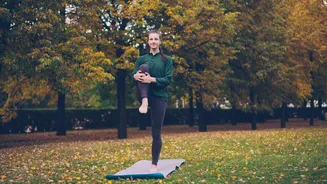


More Than Just Standing
Tadasana, from the Sanskrit words 'Tada' (mountain) and 'Asana' (pose), is a practice in stillness, posture, and presence. It's considered a foundational or 'seed' pose because it establishes the principles of alignment and body awareness that carry through
your entire yoga practice and even into daily life. Far from being passive, a correctly performed Mountain Pose is an active and engaged state, strengthening the thighs, knees, ankles, and core while improving overall posture. It creates a stable base from which all other standing poses, balances, and flows can begin with greater integrity and mindfulness.
Building Your Foundation from the Ground Up
Proper alignment is key to unlocking the benefits of Tadasana. Start by standing with your feet either together with big toes touching or hip-distance apart for better balance. Distribute your weight evenly across all four corners of each foot: the ball of the big toe, the ball of the little toe, and both sides of the heel. Lift and spread your toes to feel this connection, then gently lower them. Engage your thigh muscles by lifting your kneecaps, but avoid locking your knees. Maintain a neutral pelvis by slightly drawing your tailbone down as you lift your lower abdomen in and up. Your shoulders should be stacked directly over your hips. Roll your shoulders down and back, allowing your collarbones to broaden and your chest to open. Let your arms rest by your sides with palms facing forward as a gesture of openness. Finally, lengthen your neck and lift through the crown of your head as if a string were gently pulling you taller.
The Power of Conscious Breathing
Once your body is aligned, the focus shifts to the breath. In Tadasana, the goal is to establish a steady, calm, and even breath. A simple and effective technique is diaphragmatic or 'belly' breathing. Place one hand on your abdomen. As you inhale slowly through your nose, feel your belly expand into your hand. As you exhale, feel the belly gently contract. This style of breathing helps calm the nervous system, reduce stress, and increases lung capacity. The focus on deep, intentional breathing is what transforms Tadasana from a physical stance into a meditative practice, promoting mental clarity and focus.
Uniting Breath with Balance
The true magic of Mountain Pose happens when you sync your breath with the physical sensations of alignment. As you inhale, feel the breath creating space and length in your spine, lifting you taller from your grounded feet. As you exhale, feel yourself rooting down even more firmly into the earth. This rhythmic cycle of inhaling to lengthen and exhaling to ground creates a dynamic stability. Each conscious breath reinforces your connection to the present moment, making it easier to notice and correct subtle sways or imbalances. This mindful awareness is precisely what enhances your balance—not just in the pose, but in your ability to respond to life's challenges with a calm and centred mind.
Common Missteps and How to Correct Them
Several common habits can undermine the stability of your Mountain Pose. One is locking the knees, which creates strain and blocks the flow of energy; always maintain a 'micro-bend' in your knees. Another is distributing weight unevenly on the feet, such as leaning forward onto the toes or back onto the heels. Actively press through all four corners of your feet to correct this. Many people also tend to either slouch their shoulders forward or arch their lower back excessively. Counter this by consciously drawing your shoulder blades down your back and maintaining a neutral pelvis. Finally, avoid holding your breath. A steady, even flow of breath is essential for relaxation and stability.