






The Great Planetary Race
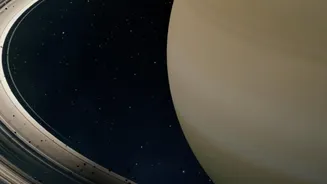
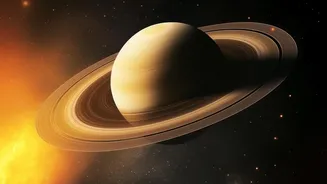
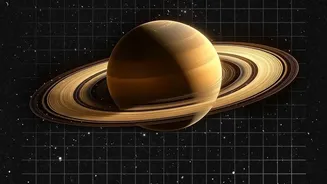
If you've ever tried to spot Saturn from night to night, you may have noticed it doesn't stay put. It drifts slowly against the backdrop of distant stars. This movement is a result of both Saturn's and Earth's orbits around the Sun. Earth, being closer
to the Sun, moves much faster in its orbit. Think of it like a race on a circular track; Earth is on the inside lane, constantly 'lapping' the outer planets like Saturn. This celestial race is what makes Saturn's position in our sky change throughout the year. Sometimes, it appears to move eastward (prograde motion), which is its normal path. But at other times, it seems to slow down, stop, and even move backward (westward) for a few months.
Retrograde Motion and Opposition
This backward movement is called 'apparent retrograde motion'. It’s an illusion, much like when you pass a slower car on a highway and it appears to move backward relative to you. This happens when Earth, in its faster orbit, catches up to and passes Saturn. The peak of this event often coincides with 'opposition', the point when Earth sits directly between the Sun and Saturn. During opposition, Saturn is at its closest and brightest for the year, making it the absolute best time for observation. It rises around sunset, is visible all night, and sets around sunrise. For 2026, Saturn's opposition occurs on October 4, making late September and October prime viewing months.
Your Pocket Planetarium
Keeping track of all this movement might seem complicated, but this is where technology comes to the rescue. Modern astronomy apps turn your smartphone into a powerful pocket planetarium. Using your phone's GPS and orientation sensors, these apps create an accurate, real-time map of the sky above you. You can simply point your phone at the sky, and the app will identify stars, constellations, and, most importantly, planets like Saturn. There's no more guesswork involved. These apps effectively bridge the gap between ancient wonder and modern convenience, making the cosmos more accessible than ever before.
Essential App Features for Saturn Spotters
While many apps can show you the night sky, certain features are particularly useful for planning your Saturn-gazing sessions. Look for an app with a powerful search function that allows you to type 'Saturn' and have the app guide you to its location. Another key feature is a 'time travel' or 'sky simulation' function. This lets you fast-forward or rewind the sky to see where Saturn will be on a future date and time, which is perfect for planning around events like opposition. Many apps also offer event notifications, which can alert you to meteor showers, conjunctions, or when a planet is at its best for viewing. Finally, an augmented reality (AR) overlay, which superimposes the star map onto your camera's live view, makes identifying objects incredibly intuitive.
Top Apps for Indian Stargazers
Several excellent astronomy apps are available for both Android and iOS users in India. For beginners, apps like 'SkyView' and 'Star Walk 2' are fantastic choices due to their user-friendly interfaces and brilliant AR features. You simply point your phone at the sky to start identifying celestial objects. 'Stellarium Mobile' is another powerful option, loved by both amateurs and seasoned astronomers for its realistic sky depiction and massive database of stars and deep-sky objects. For those specifically interested in a local context, the 'Bhagol: Indian Sky Map' app offers a unique experience, integrating traditional Indian astronomical knowledge alongside modern catalogues. Most of these apps have free versions that are more than capable of helping you find Saturn on any clear night.