




A New Player's Big Bet
Eka Robotics, a Cambridge, Massachusetts-based startup founded in 2024 by an MIT professor and a former Google DeepMind researcher, has announced a major investment into solving the problem of dexterous manipulation. The company recently closed a $150
million Series A funding round led by prominent investors Andreessen Horowitz and F-Prime, reaching a valuation of approximately $1.45 billion. This funding is aimed directly at developing robots that can handle and interact with objects with precision and adaptability, a crucial step toward creating general-purpose machines for the physical world. Eka's mission is to move beyond robots that are programmed for a single, repetitive task and create systems that can reason about the physical world. The new capital will be used to scale its unique AI model and accelerate customer deployments.
The Dexterity Challenge
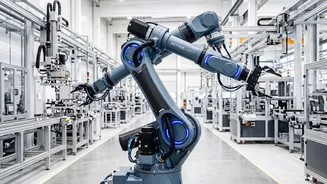
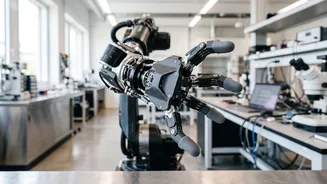
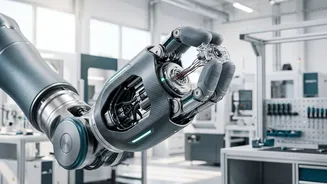
For decades, industrial robots have excelled in structured environments, like automotive plants where every part is held in a fixed position. However, the real world is messy and unpredictable. Tasks that are simple for humans, like picking a piece of fruit without crushing it or plugging in a cable, are incredibly difficult for machines. This is the 'dexterity challenge' Eka aims to solve. The company's approach is novel because it doesn't just rely on vision; it focuses on mastering physics. Eka is developing what it calls a Vision-Force-Action (VFA) model. This system combines visual data with force feedback from the robot's hand, allowing it to 'feel' an object and adjust its grip in real-time. By training the AI in physics-based simulations, the robot can practice millions of scenarios, learning how to handle unfamiliar objects, textures, and situations without being explicitly programmed for each one.
From Factory Floors to Homes
The potential applications for robots with superhuman dexterity are vast. Eka says its robots can already perform pick-and-place operations at a rate of 1,500 per hour, more than double the human average of 600. Initially, the company is focusing on industrial and logistics tasks, such as packing delicate produce or assembling complex electronics like server racks. Success in these areas could transform India's manufacturing and supply chain sectors, which are rapidly adopting automation to boost efficiency and quality under initiatives like 'Make in India'. In the long term, this technology could pave the way for robots that assist in healthcare, perform maintenance in hazardous environments, or even help with tasks in the home. The key is bridging the gap between a lab demonstration and a reliable product that can work alongside people safely and effectively.
India's Role in the Robotics Race
While Eka is a US-based startup, its mission has significant implications for India. The country is already one of the fastest-growing markets for industrial robots, with installations jumping in recent years. However, robot density remains low compared to the global average, signaling a massive opportunity for growth. The current wave of automation in India is less about replacing workers and more about augmenting them, allowing people to move to higher-value jobs while robots handle repetitive or dangerous tasks. The rise of 'cobots', or collaborative robots designed to work safely alongside humans, is a key trend. For India to become a true global manufacturing hub, it needs to not only adopt automation but also contribute to developing the core technology. Investments like the one driving Eka's research are critical for building the 'physical intelligence' that will power the next generation of automation, creating systems that are modular, adaptable, and economically viable for a wide range of industries.