





The Monsoon Menace on Indian Roads
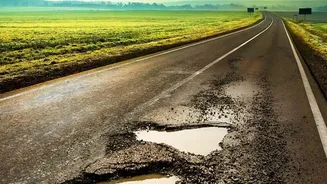
Every year, the arrival of the monsoon brings relief from the summer heat, but it also unleashes a familiar foe for Indian commuters: the pothole. The combination of heavy rainfall and traffic wears down road surfaces, leading to cracks that quickly evolve
into hazardous craters. These potholes are more than just an inconvenience; they cause vehicle damage, increase fuel consumption, lead to traffic snarls, and are a significant factor in road accidents. According to government data, thousands of accidents are attributed to potholes annually. The traditional method of reactive maintenance—patching holes with bitumen and gravel—is often a temporary fix, with the same spots deteriorating again in the next downpour.
An Indigenous Scientific Breakthrough
In response to this challenge, Indian scientists have developed a pioneering solution. Researchers at the CSIR-Central Road Research Institute (CSIR-CRRI), in collaboration with the CSIR-Indian Institute of Petroleum (CSIR-IIP), have engineered an indigenous bio-bitumen technology. This innovation aims to create more durable, sustainable, and even self-healing roads. The core idea is to move from a reactive cycle of repair to a proactive model of prevention, where the road itself has the ability to mend minor damages before they become major problems. This approach aligns with national missions to build not just more roads, but better and more resilient infrastructure.
How Bio-Binders Create 'Healing' Roads
So, how does a road heal itself? The magic lies in the binder that holds the asphalt together. Traditional roads use petroleum-based bitumen. The new technology uses bio-binders, which are derived from renewable, organic sources. In the case of the CSIR innovation, this binder is created from agricultural waste like rice straw through a process called pyrolysis, which involves heating the biomass in the absence of oxygen. This produces a bio-oil that is upgraded to a bio-binder. When mixed into asphalt, these bio-binders can have self-healing properties. Some variants work by incorporating microcapsules filled with a rejuvenating agent that ruptures when a crack forms, releasing the agent to seal the gap. Other methods involve binders that are reactivated by water or heat to restore the road's integrity. The result is a surface that can autonomously repair micro-cracks, significantly extending the pavement's lifespan.
The Environmental and Economic Edge
The advantages of bio-bitumen go beyond just fixing potholes. Environmentally, it's a major step forward. By using agricultural waste, it provides a valuable use for materials like rice straw that are often burned, causing severe air pollution. Furthermore, bio-binders are a renewable resource and have a much lower carbon footprint compared to petroleum-based bitumen, which is derived from finite fossil fuels. Economically, the benefits are equally compelling. India imports nearly half of its bitumen, costing thousands of crores in foreign exchange annually. Shifting to domestically produced bio-bitumen could drastically reduce this import dependency. While initial production costs can be higher, the long-term savings from reduced maintenance and longer road life are expected to be substantial.
The Road Ahead: Trials and Adoption
This technology is no longer confined to the laboratory. In a significant step towards real-world application, a trial stretch of road using this bio-bitumen was successfully constructed on the Jorabat-Shillong Expressway in Meghalaya. The success of such pilot projects is crucial for demonstrating the technology's performance under Indian climatic and traffic conditions. The National Highways Authority of India (NHAI) is actively exploring these innovative methods to improve road durability. However, widespread adoption will require overcoming challenges related to scaling up production, ensuring consistent quality, and managing costs. As the technology matures, these self-healing roads could move from being an experiment to becoming the new standard for highway construction in the country.