





The Allure of the Statement Sofa
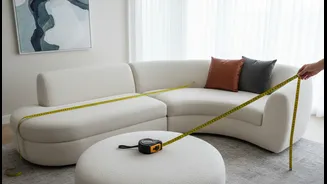
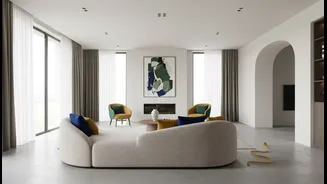
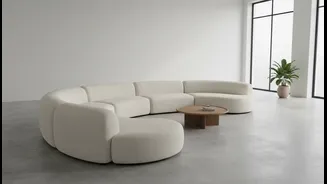
It’s easy to see why sculptural sofas have become the centrepiece of modern living rooms. With their sweeping curves, unexpected angles, and artistic presence, they do more than just offer a place to sit; they command attention. These pieces act as functional
sculptures, setting a sophisticated and contemporary tone. Whether it’s a serpentine sectional that encourages conversation or a minimalist couch with a unique silhouette, a statement sofa promises to elevate a room from ordinary to extraordinary. The mistake is assuming this visual impact comes without spatial demands. Unlike a straightforward, boxy three-seater, a sculptural sofa interacts with a room in a much more complex way.
Beyond the Footprint: Understanding Visual Weight
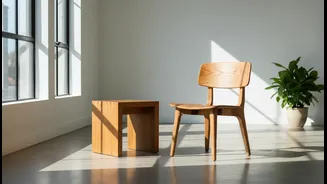
Interior designers have a term for how an object commands attention: 'visual weight'. This isn't about how much the sofa physically weighs, but how heavy it appears to the eye. A dark, bulky, solid-to-the-floor sofa has a high visual weight and can feel much larger than a sofa of the same size that sits on slender legs. Sculptural sofas, by their very nature, often carry significant visual weight. Their unique shapes—while beautiful—can dominate a space, making the room feel smaller or unbalanced if not planned for correctly. A curved sofa, for instance, pulls away from a flat wall, consuming floor area that a straight sofa wouldn’t. You’re not just fitting in its dimensions; you’re accommodating its presence.
The Tape Measure Is Your Best Friend (And a Cardboard Cutout)
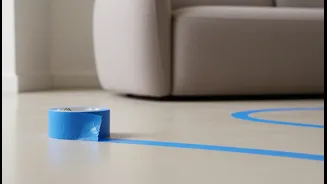
Incorrect measurements are one of the most common and costly sofa-buying mistakes. Before you fall in love, get practical. First, measure the sofa’s key dimensions: overall width, depth, and height. But don't stop there. One of the most overlooked measurements is the diagonal depth, which determines if the sofa can pivot through tight doorways and hallways. Next, measure every part of the delivery path, from your front door to stairwells and interior doorways. Once you’ve confirmed it can get inside, map out the sofa’s footprint on your living room floor using painter’s tape or by creating a cardboard template. This simple trick allows you to physically see how much space it will occupy before making the commitment.
Plan for Real-Life Traffic Flow
A beautiful sofa is useless if you can’t comfortably move around it. A room needs clear pathways for people to walk without shimmying sideways. As a rule of thumb, designers recommend leaving a minimum of 36 inches for major traffic routes, like the path from a hallway into the room. The space between your coffee table and the sofa should be around 16 to 18 inches—close enough to reach your drink, but far enough to extend your legs. When you lay down your painter's tape outline, walk around it. Can you easily get to the window? Can you access the bookshelf? Does the flow feel natural or obstructed? For a sculptural sofa, especially a curved one, this is paramount, as its shape can create awkward dead space or pinch points if not placed thoughtfully.
Consider the Entire Room's Volume
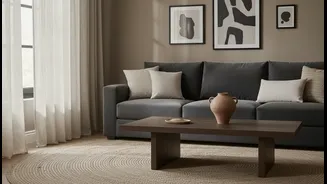
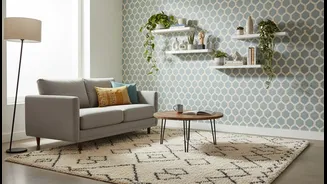
A sofa doesn’t exist in a vacuum. Its scale must be balanced with everything else in the room. A tall, bulky sofa in a room with low ceilings can feel oppressive, whereas a lower-profile design can create an illusion of height. Pay attention to the other furniture. The goal is to balance visual weight. If your sculptural sofa is visually heavy, pair it with 'leggier', more delicate pieces like a slim-legged coffee table or an airy accent chair to create contrast and balance. Even the art on the wall plays a role. A common guideline is to hang artwork that is about two-thirds to three-quarters the width of the sofa to create a cohesive visual unit. The sofa is the anchor, but it needs to be in harmony with the rest of the ship.