



The AI Co-Pilot: Smarter Satellites and Autonomous Rovers
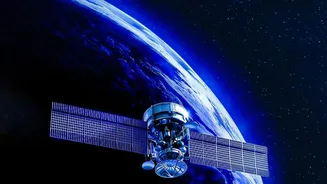
The first major upgrade comes from Artificial Intelligence. The Indian Space Research Organisation (ISRO) is moving beyond using AI just for ground-based data analysis and integrating it directly into its space hardware. Think of it as giving spacecraft
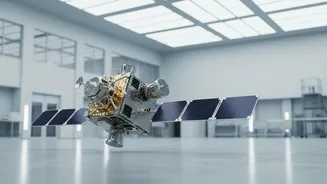
their own brains. For satellites, this means on-board AI can process massive amounts of data in orbit—a concept known as edge computing—and send back only the most critical insights. This dramatically speeds up response times for everything from disaster management and precision agriculture to military surveillance. AI has already proven its worth in navigating the Pragyan rover on the Moon during the Chandrayaan-3 mission, allowing it to autonomously identify hazards and plot a safe course. For future missions, including the Gaganyaan human spaceflight program, an AI-enabled humanoid named Vyommitra will test systems before astronauts climb aboard, acting as a robotic trailblazer.
The Quantum Leap: Unbreakable Codes and Super-Sensors
If AI is the co-pilot, quantum technology is the impenetrable forcefield. India is aggressively pursuing quantum capabilities to revolutionize two key areas: communication and sensing. The primary application is Quantum Key Distribution (QKD), a method of securing communications that is, in theory, unbreakable. Instead of traditional encryption, QKD uses the principles of quantum physics; any attempt to eavesdrop on the key exchange instantly alters it, alerting the users. ISRO has already successfully demonstrated this over a 300-meter distance and is working on satellite-based QKD to create a secure network across thousands of kilometers. This has profound implications for national security, protecting everything from military communications to financial transactions. Furthermore, quantum sensors promise to enable ultra-precise navigation and atomic clocks, making future missions more accurate than ever before.
From Theory to Launchpad: How India is Making it Happen
This futuristic vision is backed by serious investment and a clear strategy. In 2023, the Indian government approved the National Quantum Mission (NQM), an eight-year, roughly $730 million initiative to become a global leader in the field. The mission explicitly includes developing satellite-based quantum communication and building quantum computers. ISRO is working in collaboration with top academic institutions like the Indian Institutes of Technology (IITs) to develop the necessary hardware and algorithms. This push involves everything from creating specialized computer chips for space-based AI to building the foundational hardware for quantum computers. The goal isn't just to conduct experiments, but to create a robust ecosystem that integrates these advanced technologies directly into India's operational space infrastructure, including a plan to launch 50 new satellites for intelligence gathering.
More Than Just Science: The Geopolitical Stakes
India's investment in AI and quantum for its space program isn't happening in a vacuum. It represents a strategic move to secure its autonomy and elevate its status in the 21st-century space race. As space becomes more commercialized and contested, the ability to operate satellites autonomously and communicate securely is a massive strategic advantage. By developing these technologies in-house, India reduces its dependence on other nations and positions itself as a key partner for international collaborations on its own terms. This shift from being a low-cost launch provider to a high-tech innovator has implications for the United States and other space-faring nations. It signals India's ambition to not just participate in space exploration, but to help write the rules for its next era, powered by the twin engines of artificial intelligence and quantum science.