



A Cosmic Oddity
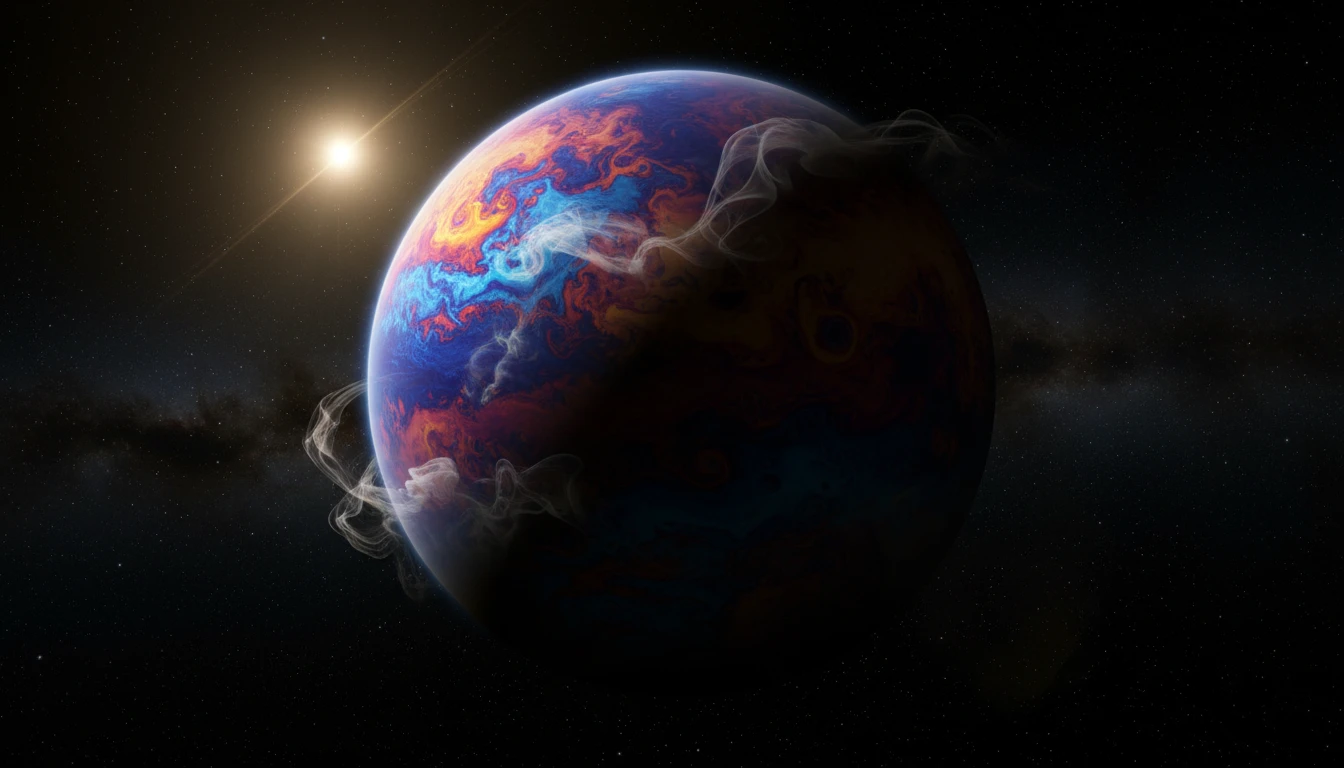
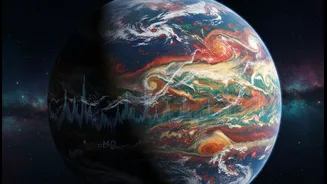
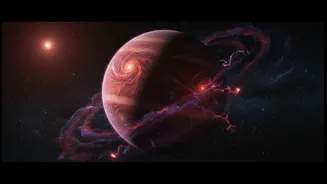
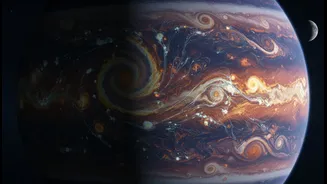
Meet WD 1856 b, a planet located about 80 light-years from Earth. It's a gas giant, roughly the size of Jupiter, but its situation is bizarre. It orbits a white dwarf—the super-dense, Earth-sized remnant of a star that was once like our Sun. This makes
the planet itself about seven times larger than the star it circles. Even stranger is its orbit. WD 1856 b whips around its dead star every 34 hours, a journey so fast and tight that it’s 50 times closer to its star than Earth is to the Sun. This proximity is the heart of a major cosmic mystery. According to everything we know about how stars die, this planet should have been vaporized.
The Stellar Death Sentence
Most stars, including our own Sun, have a predictable life cycle. Towards the end of their lives, they run out of their primary fuel and swell up dramatically, becoming what's known as a red giant. This expansion is catastrophic for any nearby worlds. In about five billion years, our Sun will expand so much that it will engulf and incinerate Mercury, Venus, and possibly even Earth. After this violent phase, the star sheds its outer layers and its core collapses into a faint, fading white dwarf. For a planet like WD 1856 b to be orbiting so closely now, it means it would have been deep inside the fiery furnace of its star's red giant phase. It should have been a goner.
Webb Unlocks the Secret
So, how did it survive? For years, this question puzzled astronomers. Now, new observations from the James Webb Space Telescope (JWST) have provided the crucial clues. A team of international scientists used Webb to analyze the planet's atmosphere as it passed in front of its star. They discovered that the planet was significantly warmer than it should be if it were only heated by the faint light of the white dwarf. This extra heat is a smoking gun. It suggests the planet wasn't always this close. The warmth is likely leftover energy from a dramatic and chaotic event that happened long after the star died. The most likely theory is that the planet migrated inwards from a much safer, distant orbit.
A Tale of Two Theories
Scientists now believe that WD 1856 b began its life far from its star, safe from the eventual red giant phase. After the star died and became a white dwarf, something disturbed the planetary system. One leading theory is that the gravitational pull of two other stars in the same system, which form a distant trio with the white dwarf, nudged the planet out of its original path. This cosmic push sent it on a new trajectory, spiraling inwards towards its current, impossibly close orbit. The intense gravitational forces during this migration would have stretched and heated the planet, explaining the residual warmth that the Webb telescope detected. The planet didn’t just survive; it was given a dramatic second act.
A Glimpse of Our Future
This discovery is more than just solving a cosmic riddle; it’s like looking into a time machine. It gives us an unprecedented preview of what might happen in our own solar system billions of years from now. While Earth’s fate remains uncertain, the survival of WD 1856 b shows that giant planets like Jupiter and Saturn can endure the death of their star. They might not stay in their current orbits, but they can persist, perhaps being thrown into new, closer paths around the Sun's white dwarf remnant. Furthermore, the Webb observations detected hydrocarbons, likely methane, in WD 1856 b’s atmosphere—the first time any atmosphere has been characterized on a planet orbiting a dead star. It proves that even after stellar death, planetary systems can remain dynamic and complex places.