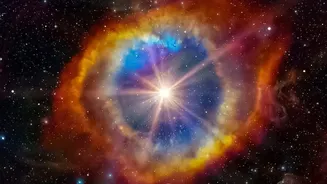


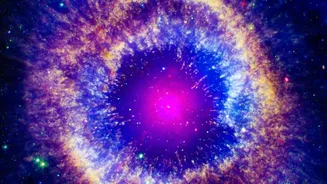
The James Webb Space Telescope has turned its powerful gaze to one of the most iconic objects in the night sky, the Helix Nebula, delivering a stunning new perspective on a cosmic mystery: thousands of strange, comet-like knots within it.
A Glimpse of Our Sun’s Future
Located about
650 light-years away in the constellation Aquarius, the Helix Nebula is what’s known as a planetary nebula. But don't let the name fool you; it has nothing to do with planets. It's the beautiful, glowing remnant of a star, much like our own Sun, nearing the end of its life. As the star ran out of fuel, it shed its outer layers of gas into space. The hot, dense core of the star, called a white dwarf, remains at the center, blasting out radiation that illuminates the expanding shells of gas, creating the spectacle we can see. Because of its relative proximity and striking appearance, astronomers have long studied the Helix Nebula as a preview of our solar system's eventual fate billions of years from now.
The Riddle of the Cometary Knots
For decades, telescopes like Hubble have observed thousands of peculiar structures inside the nebula, nicknamed "cometary knots." These aren't actual comets, which are icy bodies orbiting a star. Instead, they are massive clumps of gas and dust that, for reasons not entirely understood, have condensed into tadpole-like shapes. Each knot's dense 'head' can be twice the size of our entire solar system, with tails stretching for 100 billion miles. The prevailing theory is that as the dying star ejected its material, hotter, faster-moving winds slammed into cooler, denser gas that was shed thousands of years earlier, causing the cloud to fragment into these droplet-like knots. Their origins, however, have remained a subject of intense study and debate.
What Webb’s Infrared Eye Revealed
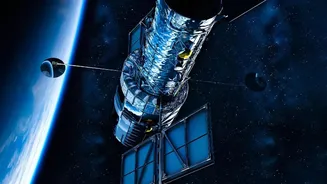
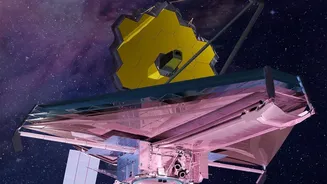
This is where the James Webb Space Telescope (JWST) changes the game. While Hubble sees the universe primarily in visible and ultraviolet light, Webb is optimized for infrared. This allows it to peer through obscuring layers of dust and detect the faint heat signatures of molecules. Webb's new images of the Helix Nebula provide the clearest view yet of these cometary knots. The telescope's NIRCam (Near-Infrared Camera) brings the knots to the forefront with astonishing detail, showing how they are sculpted by the fierce stellar winds from the central star. Webb can discern the fine structure within the knots, revealing protective pockets where molecular hydrogen—a building block for future stars—has survived the harsh radiation. This unprecedented look helps astronomers map the transition from hot ionized gas near the star to the cooler molecular gas farther out, giving crucial clues about the nebula's structure and evolution.
Why These Knots Matter
Studying these knots isn't just about solving a cosmic curiosity; it’s about understanding the life cycle of stars and matter in the universe. A star's death is also a moment of creation. The elements forged inside the star during its lifetime are cast out into the cosmos through events like the formation of a planetary nebula. This recycled material seeds the interstellar medium, the thin gas and dust between stars, providing the raw ingredients for the next generation of stars and planets. The cometary knots are a key part of this process, representing a phase where stellar material is being broken down and returned to the galaxy. By observing them in such detail, Webb is allowing scientists to witness a critical, hard-to-observe step in the cosmic recycling process that ultimately made our own existence possible.