


India’s Next Interplanetary Frontier
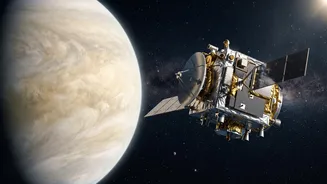
Building on the monumental successes of Chandrayaan and Mangalyaan, the Indian Space Research Organisation (ISRO) is embarking on its next great interplanetary adventure: the Venus Orbiter Mission, unofficially known as Shukrayaan. This mission marks
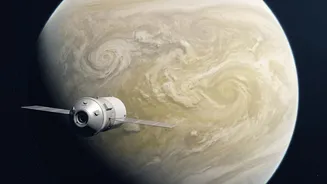
a significant step in India's space exploration journey, positioning it among a select group of global agencies aiming to unravel the mysteries of our closest planetary neighbour. Officially approved by the Indian government in September 2024, the mission is tentatively scheduled for a March 2028 launch. The spacecraft is expected to embark on a 112-day journey to reach Venus, where it will spend years studying the planet from orbit. Shukrayaan represents not just a scientific quest but also a testament to India's growing prowess in deep-space technology and exploration.
Why Venus? The Mystery of Earth's 'Evil Twin'
Venus is often called Earth's twin because of its similar size, mass, and composition. Yet, it is the most hostile planet in our solar system. Venus boasts a crushing surface pressure over 90 times that of Earth's, surface temperatures hot enough to melt lead, and a thick, toxic atmosphere of carbon dioxide choked with sulfuric acid clouds. Scientists believe Venus may have once been much more like Earth, possibly with oceans, before a runaway greenhouse effect transformed it into an inferno. Understanding why this happened is a key objective of the Shukrayaan mission. Studying Venus provides a natural laboratory for planetary climate evolution, offering invaluable insights that could help us better model and understand climate change on our own planet.
A Toolkit for a Hostile World
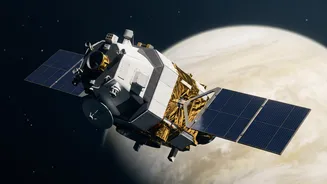
To peer beneath the thick, perpetual cloud cover of Venus, Shukrayaan will carry a payload of around 100 kg, comprising approximately 19 advanced scientific instruments. The headline instrument is a high-resolution Synthetic Aperture Radar (SAR), which can map the planet's surface in incredible detail, penetrating the dense clouds to search for active volcanoes, lava flows, and other geological features. The mission will also be the first to use a ground-penetrating radar to study the subsurface of Venus. For atmospheric analysis, the focus of the headline, the orbiter will carry a range of spectrometers and sensors. These precision instruments are designed to analyze the chemical composition of the atmosphere, study cloud dynamics, and measure how the solar wind interacts with the Venusian ionosphere.
The Search for Answers in the Clouds
The analysis of atmospheric gas chemistry is central to Shukrayaan's scientific goals. One of the key payloads for this is the Venus Infrared Atmospheric Gases Linker (VIRAL), an instrument co-developed with French and Russian space agencies. These sensors will investigate the structure, composition, and dynamics of the Venusian atmosphere. They will study the mysterious 'super-rotation' of the atmosphere, where winds whip around the planet far faster than the planet itself rotates. The instruments will also provide crucial data on the planet's extreme greenhouse effect. By creating a comprehensive, global map of Venus's atmospheric components and weather patterns, ISRO aims to provide a unique dataset that will be critical for understanding how Earth's twin became so inhospitable.
A Collaborative Global Effort
While Shukrayaan is an Indian-led mission, it incorporates significant international collaboration. Scientific payloads and expertise from countries including Sweden, France, Germany, and Russia are part of the mission. For instance, Sweden is contributing the Venusian Neutrals Analyzer (VNA), which will be part of a larger payload package designed to study the interaction between solar wind and the planet's atmosphere. This global cooperation not only enhances the scientific capabilities of the mission but also reinforces India's position as a key partner in the international space community's quest to explore our solar system. The data gathered by Shukrayaan will be shared globally, contributing to a collective understanding of this fascinating and foreboding world.