





Look up soon: one of the largest and most powerful spacecraft ever built will be soaring over Indian skies. SpaceX is targeting a mid-November launch for Starship's 15th test flight, a mission that puts India directly under its orbital path.
What Is This Giant Rocket?
Starship,
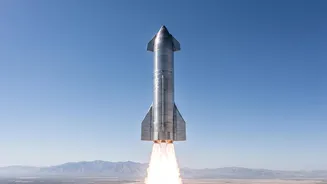
created by Elon Musk's company SpaceX, is not just another rocket; it's a completely new type of space transportation system. Standing over 120 meters tall when stacked on its 'Super Heavy' booster, it is the most powerful launch vehicle ever developed. The entire system, both the booster and the upper stage spacecraft, is designed to be fully and rapidly reusable. This is the key innovation. Instead of discarding expensive rocket stages after each launch, SpaceX aims to land, refuel, and fly them again, drastically cutting the cost of accessing space. The ultimate vision for Starship is ambitious: carrying up to 100 people on missions to the Moon, Mars, and beyond.
The Upcoming Mission and Its Path
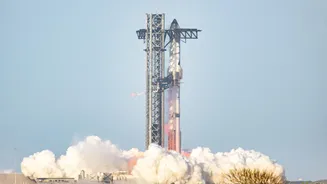
The next mission, known as Starship Flight 15, is a major step. The launch is targeted for as early as November 13 from Texas, USA, which corresponds to the early hours of November 14 in India. Unlike previous shorter tests, this flight is planned to last over 22 hours, completing roughly 14 orbits of the Earth. It is this long-duration, high-inclination orbit that will bring the spacecraft over parts of India multiple times during its journey. The flight has two groundbreaking objectives: deploying a batch of 26 new Starlink internet satellites and, for the first time, attempting to catch both the Super Heavy booster and the Starship spacecraft back at the launch site using giant mechanical arms. Success would mark the first full recovery of an orbital rocket system in history.
When and Where to Look Up
For skywatchers in India, the mission offers a rare opportunity. Given the launch window opens early on November 14 IST, the vehicle would make several passes over the following 22 hours. The exact visibility will depend on the final launch time, the precise orbital track, and local weather conditions. If a pass occurs during dawn or dusk, observers on the ground might see a bright, fast-moving point of light as the massive vehicle, flying at an altitude of around 275 kilometres, reflects sunlight against a dark sky. It will travel much faster than an airplane and will not blink. While the launch itself is subject to regulatory approval and could be delayed, the prospect of seeing this historic vehicle has space enthusiasts across the nation preparing to watch the skies.
More Than Just a Flyby
This event is significant beyond being a celestial spectacle. Starship represents a seismic shift in the space industry, moving from government-led exploration to a new era of commercial innovation. A fully reusable rocket with Starship’s payload capacity could make launching large space telescopes, building lunar bases, and even interplanetary travel far more feasible and frequent. The vehicle is already contracted by NASA to serve as the landing system for its Artemis missions, which will return humans to the Moon. For India, the flyover is a visible reminder of how rapidly the global space landscape is evolving. It underscores the growing importance of commercial players and presents both a competitive challenge and a potential opportunity for collaboration with India’s own esteemed space program, ISRO.