
A Long Journey to a Water World
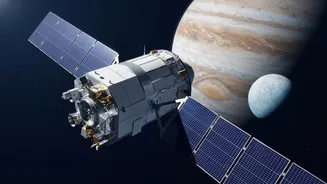
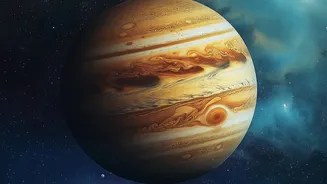
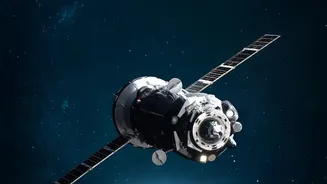
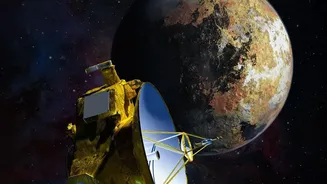
Launched in October 2024, the Europa Clipper spacecraft is undertaking a nearly six-year, 2.9-billion-kilometre voyage to the Jupiter system. As of late 2026, it is cruising through the solar system, preparing for a critical gravity-assist flyby of Earth
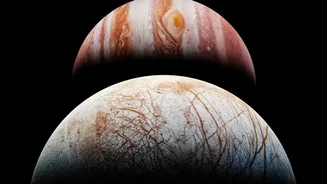
in December 2026 that will slingshot it toward its ultimate destination. Arrival is scheduled for April 2030. The mission's primary goal is not to find life itself, but to determine if Europa has all the necessary ingredients for it: liquid water, the right chemical elements, and a source of energy. Europa is considered one of the most promising places to search for habitable environments because evidence strongly suggests its ocean contains more than twice the water of all of Earth's oceans combined.
The Toolkit for an Icy Moon
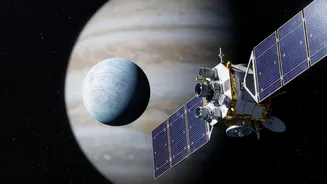
To investigate a world from afar, you need a sophisticated set of tools. Europa Clipper carries nine primary science instruments, each designed to answer a different piece of the habitability puzzle. These instruments are heavily shielded inside an aluminum-titanium vault to protect them from Jupiter's intense radiation. Instead of orbiting the hazardous environment of Europa directly, the spacecraft will orbit Jupiter and perform approximately 49 close flybys of the moon, some as low as 25 kilometres above the surface. During each pass, the instruments will work in concert to gather data on the moon's ice shell, ocean, composition, and geology.
Peering Beneath the Ice
So, how do you study an ocean you cannot see? A few key instruments are designed to do just that. The Radar for Europa Assessment and Sounding: Ocean to Near-surface (REASON) instrument will use ice-penetrating radar to measure the thickness of the ice shell, search for pockets of water within the ice, and hopefully confirm the ocean's existence and depth. Meanwhile, the Europa Clipper Magnetometer (ECM) will measure the strength and direction of the moon's magnetic field. Since a salty ocean would distort Jupiter’s magnetic field in a predictable way, these measurements can help determine the ocean's depth and saltiness without ever touching it.
Sniffing for Life's Ingredients
The mission will also hunt for clues in the space right around Europa. Scientists are hopeful that plumes of water vapour may be erupting from the moon's surface, offering a direct sample of what lies beneath. The SUrface Dust Analyzer (SUDA) is designed to scoop up tiny particles of ice and dust ejected from the surface and analyse their chemical makeup. If a plume is active, SUDA could potentially identify salts or even organic molecules from the ocean below. Complementing this is the MAss Spectrometer for Planetary EXploration (MASPEX), which will analyse gases in Europa’s extremely thin atmosphere, providing another way to detect what chemicals are present on the surface and potentially originating from the ocean.
Mapping a Mysterious Surface
High-resolution cameras will provide our best-ever look at Europa's fractured surface. The Europa Imaging System (EIS), with its wide and narrow-angle cameras, will map the geology, look for signs of recent activity, and help scientists understand the processes that shape the ice. At the same time, the Europa Thermal Emission Imaging System (E-THEMIS) will scan the surface for temperature differences. This thermal imager can spot warmer areas that might indicate where the ice shell is thinner or where ocean water may have recently erupted. Together, these instruments will create a comprehensive global map to guide future exploration.