




Why All Eyes Are on Europa
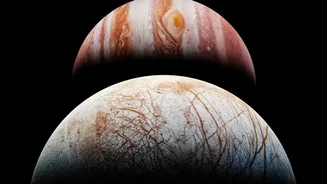
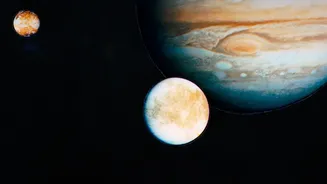
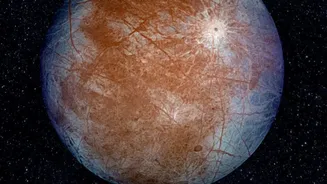
Europa may be smaller than Earth's moon, but it holds a secret that makes it one of the most compelling destinations in our solar system: a colossal saltwater ocean. Scientists estimate this ocean, hidden beneath a thick crust of ice, could contain more
than twice the amount of water found in all of Earth's oceans combined. This fact alone makes it a prime candidate in the search for habitable environments. The evidence for this ocean came from NASA's Galileo mission in the 1990s, which detected a distorted magnetic field around Europa. Scientists believe the most plausible explanation is a global ocean of conductive, salty water. But water is just one part of the recipe for life. Scientists believe Europa also has the other two key ingredients: the right chemical elements (like carbon, hydrogen, and oxygen) and a source of energy. The immense gravity of Jupiter constantly tugs and flexes the moon, creating tidal heat that could keep the ocean liquid and potentially power hydrothermal vents on the seafloor, similar to those on Earth that teem with life.
The Interplanetary Detective
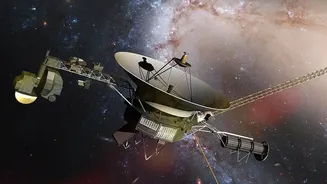
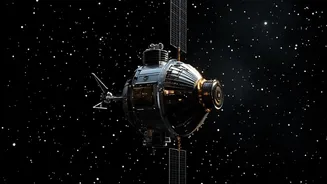
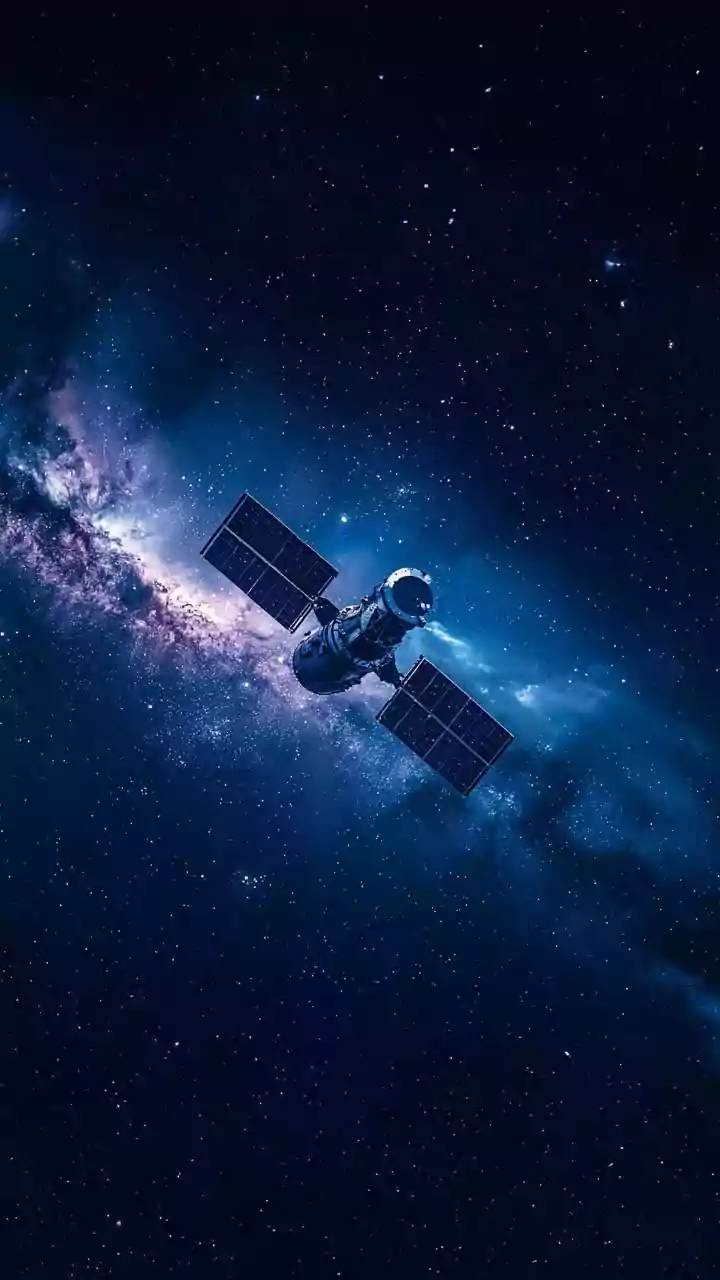
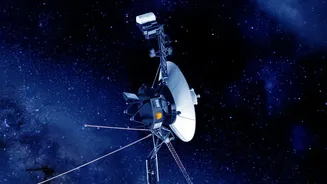
To investigate this mysterious world, NASA built the Europa Clipper, the largest interplanetary spacecraft the agency has ever launched. With its solar arrays deployed, it spans the length of a basketball court, needed to gather enough sunlight for power so far from the Sun. The spacecraft is equipped with a sophisticated suite of nine scientific instruments, shielded inside a heavy-duty radiation vault to protect them from Jupiter's harsh environment. These tools will work together to paint a comprehensive picture of Europa. An ice-penetrating radar called REASON is designed to measure the thickness of the ice shell, which could be up to 30 kilometers deep, and search for pockets of water within it. Spectrometers will analyze the surface's chemical composition, looking for salts and organic molecules that might give clues about the ocean below. A magnetometer will take precise measurements of the magnetic field to confirm the ocean's existence, depth, and salinity. The mission even has cameras capable of mapping the majority of the moon's surface in stunning high resolution, far exceeding the detail of previous images.
A Long and Carefully Planned Journey
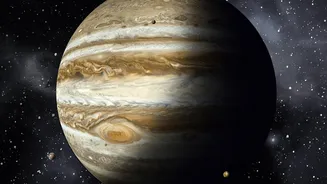
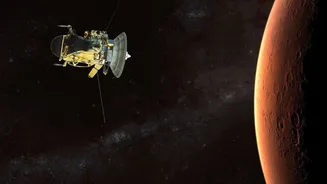
Getting to Europa is a marathon, not a sprint. The Clipper launched on a SpaceX Falcon Heavy rocket on October 14, 2024. It's now on a 2.9-billion-kilometre voyage that will take over five years. To build up enough speed to reach the outer solar system, the spacecraft is performing several gravity-assist flybys. It used Mars for a speed boost in March 2025 and is scheduled to swing by Earth in December 2026 for its final push. The spacecraft is expected to arrive in orbit around Jupiter in April 2030. However, it won't orbit Europa directly. The radiation trapped by Jupiter's massive magnetic field is so intense that it would quickly damage the spacecraft's electronics. Instead, Clipper will circle Jupiter in a long, looping orbit, making dozens of close, quick flybys of Europa. During these encounters, it will swoop as low as 25 kilometers above the surface, gathering as much data as possible before retreating to the comparative safety of its wider Jupiter orbit.
The Search for Habitability, Not Aliens
It's important to understand that Europa Clipper is not a life-detection mission. Its main goal is to determine if Europa has habitable environments — places that could support life as we know it. It doesn't have the tools to find microbes in the water. Instead, it will assess the three key ingredients: the properties of the water, the chemistry of the surface and potential plumes, and the geologic activity that could transport nutrients. Scientists are particularly hopeful that the spacecraft might be able to fly through and sample plumes of water vapor that may be erupting from the moon's surface, offering a direct taste of what's in the hidden ocean without having to drill through the ice. A successful mission would tell us whether Europa's ocean is a warm, salty, and chemically rich environment. Finding such conditions would be a monumental discovery in its own right, marking the first detailed exploration of a potentially habitable ocean world beyond our own and paving the way for future missions that could one day search for life itself.