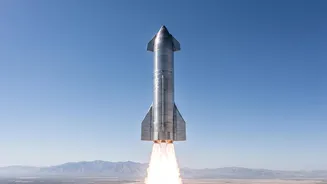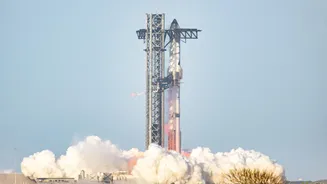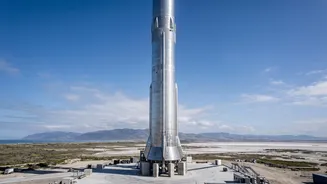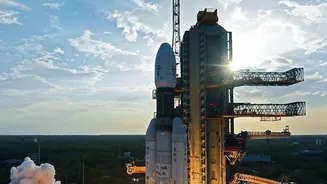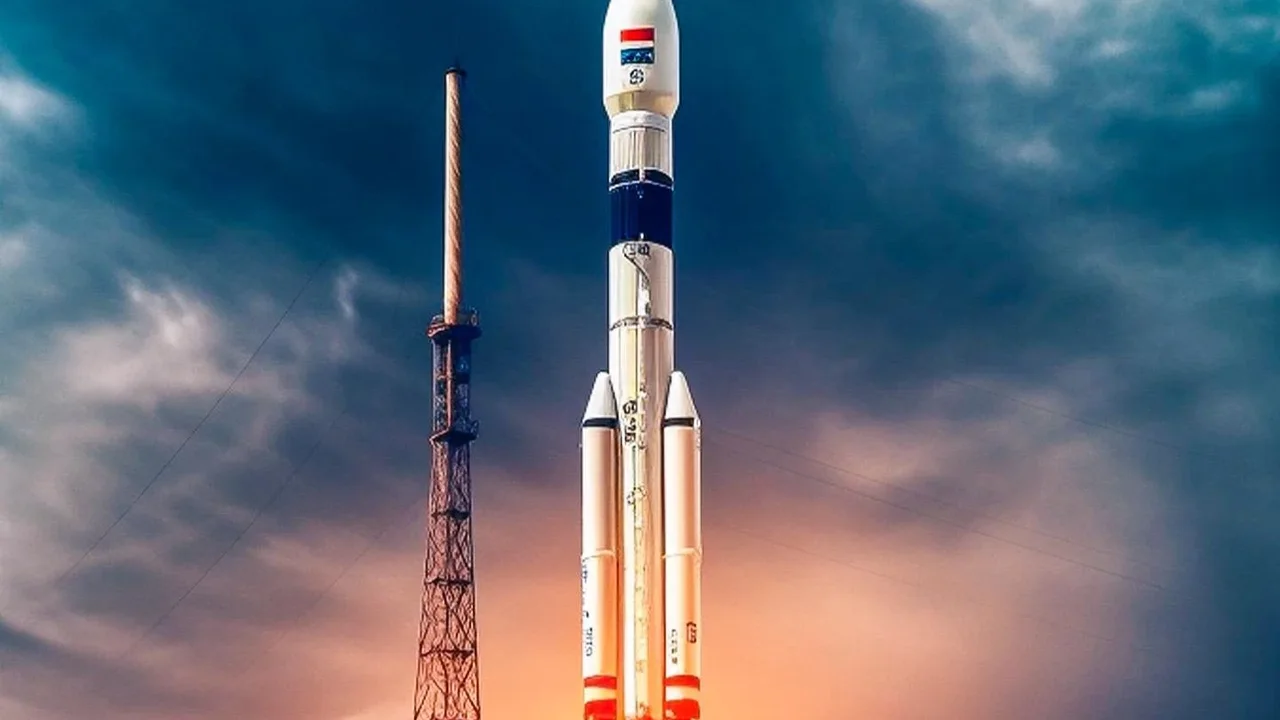





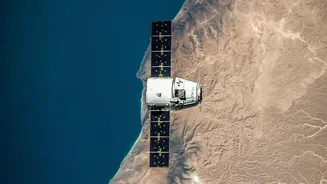


The world’s largest rocket may soon be visible in Indian skies. SpaceX's ambitious plans for its next Starship test flight include a trajectory that brings the colossal vehicle over India multiple times, offering a rare sighting.
What is Starship?
Starship is SpaceX's next-generation,
fully reusable transportation system, designed to carry both crew and cargo to Earth orbit, the Moon, Mars, and beyond. Standing taller than any rocket ever built, it consists of two parts: a Super Heavy booster and the Starship upper stage. The entire system is engineered to be rapidly reusable, a breakthrough that SpaceX believes will dramatically lower the cost of space travel. After reaching orbit for the first time on its 14th flight in September 2026, the program is moving at a rapid pace. The upcoming 15th flight is one of its most ambitious yet, aiming to not only orbit the Earth but also to have both the booster and the spacecraft return to the launch site to be caught by giant mechanical arms.
The Flight Plan Over India
The upcoming mission, designated Flight 15, is scheduled to launch from Starbase, Texas, as soon as November 14, 2026, pending final regulatory approval. The flight plan is for Starship to spend over 22 hours in orbit, circling the Earth approximately 14 times before attempting its return. It is during these multiple orbits that the spacecraft's ground track will repeatedly pass over parts of the Indian subcontinent. This provides a potential opportunity for skywatchers in India to spot the massive vehicle as it travels at an altitude of around 275 kilometres. This flyover is not a special detour but a fundamental consequence of the vehicle's orbital path and the Earth's rotation beneath it. As Starship circles the globe, its path relative to the ground shifts with each 90-minute orbit.
Is It Safe?
While the idea of a spacecraft flying overhead might raise questions, these operations are conducted at extremely high altitudes, far above commercial air traffic. Furthermore, the flight plan includes numerous safety protocols. For this specific mission, Starship will initially launch into what is called a 'passively safe suborbital trajectory'. This means that even if its engines fail to perform the final burn to enter a stable orbit, the spacecraft would naturally and safely re-enter the atmosphere over a cleared, unpopulated area of the Indian Ocean. Only after flight controllers confirm all systems are healthy will they give the 'go' to proceed into a stable orbit. The Indian Ocean has been a designated contingency splashdown zone for several previous Starship flights as well.
Why This Trajectory Matters
The flight path for Flight 15 is dictated by its primary mission: to deploy a batch of 26 Starlink internet satellites and then demonstrate a full, powered return to its Texas launch site for a landing attempt. Completing 14 orbits over 22 hours allows the Earth to rotate into the correct position so that Starship's de_orbit burn and atmospheric re_entry places it on a precise course back to Starbase. The de_orbit burn itself is nominally planned to occur over the South Indian Ocean. For India, these repeated flyovers are a visual symbol of the country's position under the flight paths of the new global space age. While this mission does not involve direct collaboration with Indian agencies, it underscores the interconnected nature of modern spaceflight, where orbital mechanics make neighbours of all nations.
A New Era of Spaceflight
Each Starship test flight is a step toward making humanity a multi_planetary species, according to SpaceX founder Elon Musk. NASA is also a key stakeholder, having selected Starship as the landing system to return astronauts to the Moon for its Artemis program, with the first crewed lunar landing now targeted for 2028. To achieve these goals, SpaceX needs to prove that Starship can fly, land, and be reused reliably and frequently. The upcoming flight is a critical test of this capability, particularly the first_ever attempt to catch the Starship upper stage after it returns from orbit. A success would be a landmark achievement, validating the core concept of a fully and rapidly reusable launch system and paving the way for cheaper, more accessible space travel.