




An Alien Earth
Titan is one of the most intriguing bodies in our solar system. It is the only moon with a thick atmosphere, primarily made of nitrogen like Earth's, but with a significant amount of methane. This creates a bizarre, yet familiar, world. Titan has a weather
cycle with clouds, rain, rivers, lakes, and seas, but instead of water, liquid methane and ethane flow across its frigid surface. High in its hazy, orange atmosphere, sunlight and energetic particles break down nitrogen and methane, creating a complex soup of organic molecules that rain down onto the surface. Scientists believe this environment could be a planetary-scale laboratory for studying prebiotic chemistry—the chemical steps that might have led to life on our own planet.
Introducing Dragonfly: A Nuclear-Powered Drone
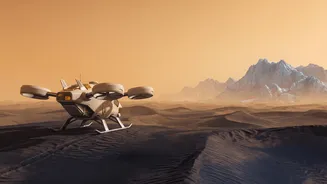
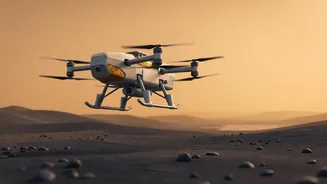
To explore this diverse and complex landscape, NASA is sending Dragonfly, a revolutionary car-sized rotorcraft. Scheduled for launch in July 2028, it will take about six and a half years to reach Titan, arriving in 2034. Unlike stationary landers or slow-moving rovers, Dragonfly is a dual-quadcopter designed to fly through Titan's dense atmosphere. This is possible because Titan's atmosphere is four times denser than Earth's and its gravity is much lower, making flight easier. Powered by a nuclear source called a Multi-Mission Radioisotope Thermoelectric Generator (MMRTG), the same type used on the Curiosity and Perseverance Mars rovers, Dragonfly will be able to operate for years, flying from one location to another. This mobility is key, allowing it to sample dozens of different geological sites across hundreds of kilometers.
The Search for Life's Building Blocks
Dragonfly's primary objective is not to find existing life, but to search for the chemical building blocks and processes that could lead to it. Titan is a treasure trove of complex organic materials, which contain carbon, hydrogen, and nitrogen—essential ingredients for life as we know it. Scientists want to understand how far this prebiotic chemistry has progressed. Of particular interest are locations where liquid water from past impacts or potential cryovolcanic flows might have mixed with the surface organics. This interaction between water and complex carbon compounds is considered a crucial step in the origin of life. By studying these areas, Dragonfly could provide a snapshot of the chemical pathways that may have occurred on early Earth but have long since been erased by geological activity and biology.
A Flying Chemistry Lab
To accomplish its goals, Dragonfly is equipped with a sophisticated suite of scientific instruments. The Drill for Acquisition of Complex Organics (DrACO) will collect samples from just beneath the surface. These materials will then be pneumatically transferred to the Dragonfly Mass Spectrometer (DraMS), a powerful tool that will analyze the precise chemical composition of the samples to identify complex organic molecules, such as amino acids or other prebiotic compounds. The Dragonfly Gamma-Ray and Neutron Spectrometer (DraGNS) will measure the elemental composition of the surface without even needing to touch it, while the Dragonfly Camera suite (DragonCam) will provide detailed images of the terrain. Together, these instruments will operate as a mobile laboratory, allowing scientists to piece together the chemical story of each location Dragonfly visits.
An Ambitious Itinerary
The mission is planned to last for over three years on Titan's surface. After landing in the Shangri-La dune fields near the moon's equator, Dragonfly will begin a series of short flights. It is designed to fly up to 8 kilometers in a single hop, recharging between flights. The ultimate destination is the Selk impact crater, a site where scientists believe heat from the impact may have melted water ice, allowing it to mix with the rich organic materials present on the surface. Analyzing samples from this area could provide the most direct evidence of whether Titan has hosted the conditions necessary for life's chemistry to begin. The mission's ability to traverse large distances and sample diverse environments represents a new paradigm in planetary exploration, one that could unlock some of the deepest secrets of our solar system.