
The Myth of Eternal Stability
The question of the solar system's long-term stability has fascinated astronomers since Isaac Newton first formulated the laws of gravity. While he suspected the planets might eventually fall into disarray, later mathematicians suggested the orbits were
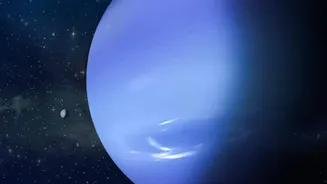
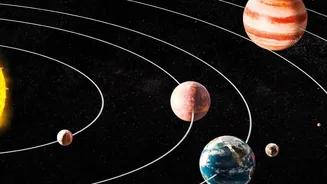
largely stable. For decades, the prevailing wisdom, backed by computational research, was that our planetary arrangement was secure. While the inner planets like Mercury face a tiny, one-percent chance of destabilization over the next few billion years, the outer solar system—the giants Jupiter, Saturn, Uranus, and Neptune—was thought to be extraordinarily robust. Previous simulations predicted their stately dance would continue for 30 to 100 billion years, long after the Sun itself had died. Even accounting for our star's eventual transition into a white dwarf, the basic architecture of our solar system was expected to outlive the current age of the universe many times over. This picture provided a sense of cosmic permanence, a belief that our corner of the galaxy was a rare example of enduring order.
A Sun's Messy End
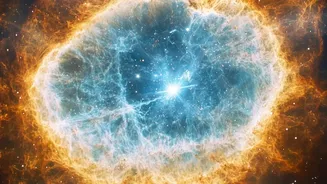
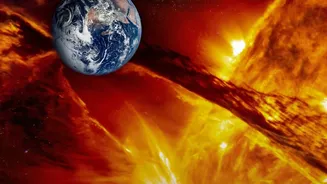
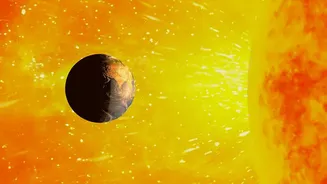
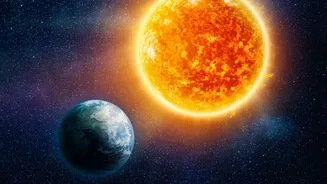
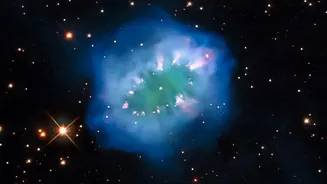
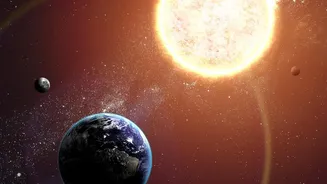
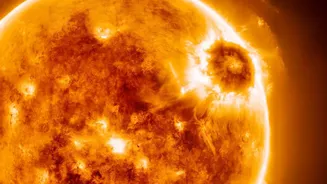
A new study led by Caltech's renowned planetary astrophysicist Konstantin Batygin challenges that comforting assumption. The flaw in previous models, his team argues, was how they handled the Sun's death. In about five billion years, the Sun will exhaust its primary fuel, swell into a red giant, and eventually shed about half its mass to become a dense white dwarf. Earlier models treated this mass loss as a smooth, gentle process, like a slowly deflating balloon. But the reality is far more violent. As stars like our Sun die, they don't just fade away; they expel their mass in a series of sporadic, powerful ejections. Batygin's new simulations incorporate these random directional 'kicks' for the first time. Each ejection will shove our star slightly, altering its gravitational pull on the remaining planets in unpredictable ways. It’s the difference between a car slowly rolling to a stop versus one sputtering and lurching violently.
Orbits Unravelled by Chaos
The consequences of these solar kicks are dramatic. When Batygin's team ran their simulations with this more realistic model of the Sun's end, the stable, predictable outer solar system fell apart. The slight, random changes in gravity, accumulating over millions of years, introduce chaos into the planetary orbits. Instead of remaining in their wide, orderly paths, the giant planets begin to influence one another destructively. Their orbits cross, and the delicate gravitational balance that has held for billions of years is shattered. The results are startling: the simulations show that in roughly 90% of scenarios, the outer solar system breaks down within just three billion years of the Sun becoming a white dwarf. Even more surprisingly, about 40% of the simulations showed this violent scattering happening while the Sun is still in its red giant phase, far earlier than ever expected.
A New, Shorter Cosmic Timeline
This research effectively rewrites the final chapter of our solar system. The expected lifespan of our planetary configuration has been slashed from a near-eternal 100 billion years to a 'meager' one billion years after the Sun's main sequence life ends. The most likely outcome is that at least one, and possibly more, of our majestic gas giants will be ejected entirely, flung into the cold, dark expanse of interstellar space to wander as an orphan planet. While this cosmic drama is slated for the very distant future—Earth itself will be uninhabitable long before then—it fundamentally changes our understanding of how planetary systems evolve and die. It suggests that chaos, not order, is the ultimate rule. Our solar system isn't a timeless piece of clockwork but a temporary arrangement, a survivor of a chaotic past and the subject of an equally chaotic future.