



Why We Search for Water
On Earth, water is a fundamental ingredient for life as we know it. From the smallest microbe to the largest whale, life depends on it. This makes the search for water on other worlds a top priority for astronomers. Finding water vapor in the atmosphere
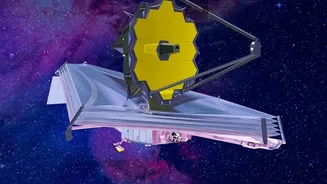
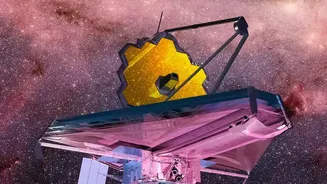
of a distant planet, or exoplanet, doesn't guarantee life, but it’s a crucial first step. It signals that a planet might have the right conditions for life to emerge. Until the launch of the JWST, detecting these faint water signatures on planets hundreds of light-years away was incredibly difficult.
Seeing the Universe in Infrared
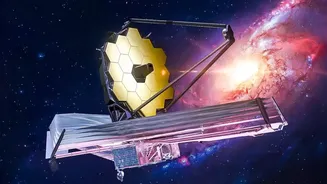
Much of the universe is hidden from our eyes, which only see a narrow band of light known as the visible spectrum. But the cosmos is teeming with other types of light, including infrared. You can think of infrared as heat radiation; everything with warmth emits it. The JWST is specifically designed to detect this invisible infrared light. This is vital for two reasons. Firstly, the most distant and earliest galaxies have had their light stretched into the infrared part of the spectrum by the expansion of the universe. Secondly, and most importantly for planet hunters, infrared light holds the chemical fingerprints of molecules like water.
How Webb Reads an Atmosphere
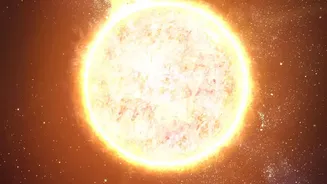
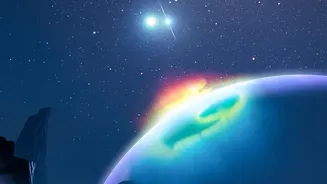
Webb uses a technique called transit spectroscopy to find water. When an exoplanet passes in front of its host star from our perspective, a tiny fraction of the starlight filters through the planet's atmosphere. Different molecules in that atmosphere absorb specific wavelengths, or colors, of light. Water vapor, for example, has a unique absorption signature in the infrared range. By capturing the starlight that has passed through the atmosphere and breaking it down into a spectrum—like a rainbow—astronomers can see which wavelengths are missing. These missing pieces, or absorption lines, create a distinct pattern that tells scientists that water is present.
A Toolkit for Cosmic Chemistry
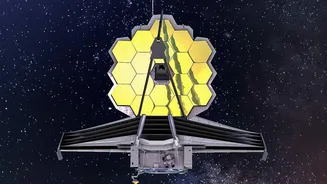
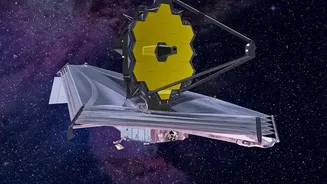
To perform this intricate analysis, JWST is equipped with a suite of highly sensitive instruments. The Near-Infrared Spectrograph (NIRSpec) and the Mid-Infrared Instrument (MIRI) are two of its key tools. NIRSpec can observe over 100 objects simultaneously, breaking their light into spectra to identify their chemical composition, temperature, and mass. MIRI is sensitive to longer infrared wavelengths, allowing it to study everything from newly forming stars to the faint light of distant galaxies and the makeup of icy objects in our own solar system. These instruments work together to capture the full range of infrared data needed to unambiguously identify water and other molecules in an exoplanet's sky.
A Leap for Planetary Science
Since beginning its mission, JWST has already delivered groundbreaking results. It has confirmed the presence of water vapor in the atmospheres of several exoplanets, including hot gas giants and smaller sub-Neptune worlds. In one surprising discovery, Webb even detected water in a planet-forming disk around the star PDS 70, in the very region where rocky, Earth-like planets might be assembling. This suggests that planets could be born with water readily available. Before Webb, these kinds of precise measurements were impossible, marking a huge leap forward in our ability to characterize worlds beyond our solar system.