


The Goldilocks Zone Isn't Enough
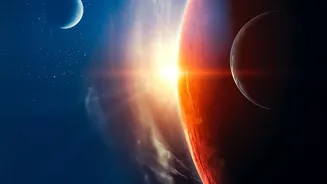
The concept of a habitable zone is a foundational tool for astronomers. It defines the range of distances from a star where a planet could potentially maintain liquid surface water, a key ingredient for life as we know it. If a planet is too close to its
star, its water boils away; too far, and it freezes. While this concept has successfully narrowed the search for Earth-like worlds, it's an incomplete picture. A growing body of research shows that many other factors determine true habitability, and one of the most important is a planet’s mass and radius. A planet can be in the perfect location, but if it's the wrong size, its chances of hosting life plummet.
The Problem with Being Too Small
A small planet simply doesn't have the gravitational muscle to hold on to its atmosphere over cosmic timescales. Mars is a prime local example. While it sits on the outer edge of our sun's habitable zone, its small size—about half the diameter of Earth—meant it couldn't retain a thick atmosphere. Over billions of years, the sun's radiation stripped away most of its protective gaseous blanket, and any surface water evaporated or froze. Recent models suggest a critical threshold exists. Planets smaller than about 0.8 times the radius of Earth are likely to lose their atmospheres relatively quickly. This is due to two compounding issues: weak gravity makes it easy for atmospheric gases to escape into space, and a small planet's core cools faster. A cooler core means less volcanic activity, which is a key process for replenishing an atmosphere from the planet's interior.
The Danger of Being Too Big
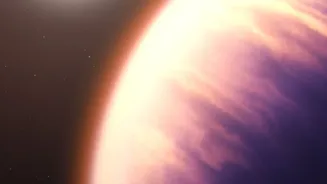
If being too small is a problem, so is being too big. As planets grow in size, they transition from rocky, terrestrial worlds into what are known as "mini-Neptunes" or "gas dwarfs." These worlds, which are common in the galaxy, have enough gravity to hang onto thick, crushing atmospheres made primarily of hydrogen and helium, much like Neptune or Uranus. Even if a mini-Neptune orbits within the habitable zone, its surface conditions would be inhospitable for life as we know it, lacking a solid surface and featuring immense atmospheric pressure. Furthermore, planets that are significantly larger than Earth and located on the inner edge of a habitable zone can fall victim to a runaway greenhouse effect. Their immense gravity holds onto vast amounts of water vapor, a potent greenhouse gas, which traps so much heat that the oceans boil away, turning the world into a sterile steam-bath like Venus.
Finding the 'Just Right' Size
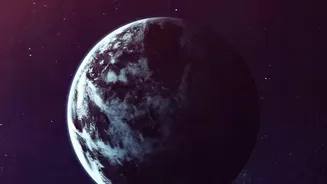
This leaves a 'Goldilocks' range for size, not just distance. The sweet spot appears to be for rocky planets, or "super-Earths," that are larger and more massive than our own planet but not so big that they become gas giants. A planet up to about 1.6 times Earth's radius is still likely to be terrestrial. These larger rocky worlds are excellent candidates in the search for life. Their stronger gravity makes them better at retaining atmospheres, and their larger, hotter cores could drive vigorous geological activity like plate tectonics for billions of years. This activity is crucial for regulating a planet's climate and cycling nutrients, processes that have been vital for life on Earth. However, there's a delicate balance. Some studies suggest the crust on a super-Earth might be too strong for plate tectonics to occur.
A More Nuanced Search for Life
Understanding the role of planetary size is transforming the hunt for habitable worlds. Instead of just flagging any planet in a habitable zone, astronomers are now cross-referencing that data with a planet's mass and radius to create a more promising shortlist. This refined approach allows scientists to use precious telescope time, like that of the James Webb Space Telescope, more efficiently, focusing on worlds that have both the right location and the right physical properties. It acknowledges that habitability isn't a simple label but the result of a complex interplay between a planet, its star, and its history. The more we learn, the more we realize that finding another Earth requires looking for a world that is 'just right' in more ways than one.