





Why Grey Days Drain Your Brain
Our bodies are naturally tuned to the rhythm of the sun. Bright, natural light signals our brains to be alert and awake by regulating hormones like serotonin and melatonin. On overcast days, the lack of sunlight can disrupt this internal clock, leading
to feelings of sluggishness, low energy, and even sadness. This phenomenon, sometimes a mild form of Seasonal Affective Disorder (SAD), makes it harder to concentrate and stay productive. When your home office relies too heavily on whatever natural light trickles through the window, a grey day means you’re essentially working in a state of perpetual twilight, forcing your eyes and brain to work harder.
The Problem with a Single Light Source
Many home offices are lit by a single overhead fixture, which is often inadequate, especially on dim days. This setup creates a high-contrast environment where your bright screen is surrounded by relative darkness. Your eyes are forced to constantly adjust, leading to digital eye strain, fatigue, headaches, and blurred vision. Furthermore, a single light from above or behind you can cast shadows and create glare on your monitor, making it difficult to see clearly and further straining your eyes. Relying on this one source means you're either working in shadows or dealing with harsh reflections, neither of which is conducive to comfortable, focused work.
The Solution: Layer Your Lighting
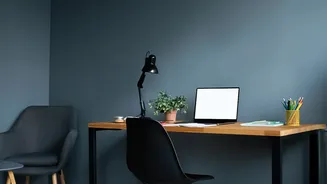
Instead of relying on one light, professionals recommend a layered approach to create an evenly lit, adaptable workspace. This involves combining three types of lighting. The first is ambient light, which is the general illumination for the entire room from an overhead fixture. The second is task lighting, a focused light for your immediate work area, such as an adjustable desk lamp. This is crucial for reducing eye strain during activities like reading or writing. The third is accent lighting, which can be used to highlight features like artwork or bookshelves, adding depth and reducing dark spots in the room. On a grey day, having all three layers available allows you to compensate for the lack of natural light effectively.
Choose the Right Colour and Brightness
Not all light is created equal. The colour temperature of a bulb, measured in Kelvins (K), has a psychological impact. For a work environment where focus is key, experts recommend a cool, neutral white light between 4000K and 5000K. This range mimics natural daylight, which can help you feel more alert and productive. In contrast, warmer tones below 3000K are better for relaxation and winding down. On an overcast day, switching your task and ambient lights to a cooler temperature can help counteract the gloomy, sleepy feeling induced by the weather. Brightness, measured in lumens, is also key. Ensure your workspace is lit to a comfortable level of 300 to 500 lux to avoid strain.
Embrace Smart Lighting for Automation
For the ultimate convenience, consider upgrading to a smart lighting system. Smart bulbs and fixtures can be controlled via an app or voice assistant, allowing you to adjust brightness and colour temperature with ease. You can create preset “scenes” for different situations, such as “Focus Work” for a bright, cool light on a grey day, or “Evening Wind-Down” with a warm, dim glow. Some advanced systems can even be programmed to automatically adjust throughout the day to mirror natural circadian rhythms, helping to improve well-being and productivity regardless of the weather outside. This allows you to maintain a consistent and supportive lighting environment with minimal effort.