





The Sun's Grand Performance
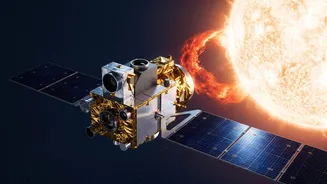
At the heart of this celestial spectacle is the sun's natural rhythm, known as the solar cycle. Approximately every 11 years, our star transitions from a period of quiet (solar minimum) to a peak of intense activity (solar maximum). We are currently in Solar
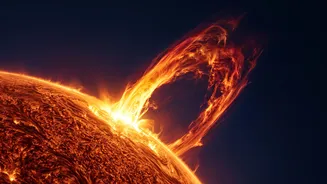
Cycle 25, which began in 2019. During solar maximum, the sun's surface becomes a hotbed of activity, marked by an increase in sunspots—dark, complex magnetic regions. These sunspots are the source of powerful solar flares and massive eruptions called coronal mass ejections (CMEs), which hurl vast clouds of charged particles into space.
From Solar Storm to Earthly Light
When a CME is aimed at Earth, its stream of energetic particles, known as the solar wind, embarks on a journey across the solar system. Most of these particles are deflected by our planet's protective magnetic field, the magnetosphere. However, some become trapped and are funnelled down along magnetic field lines toward the North and South Poles. As these high-energy particles collide with atoms and molecules—primarily oxygen and nitrogen—in our upper atmosphere, they transfer energy, causing the gases to glow. This interaction creates the beautiful, dancing ribbons of light we know as the aurora. The colours depend on which gas is struck and at what altitude: oxygen typically produces the common green and rarer red hues, while nitrogen can create shades of blue and purple.
Why 2026 is an Aurora Hunter's Dream
Solar Cycle 25 has been stronger than initially predicted, reaching its maximum phase around late 2024 and expected to remain highly active through 2026. This heightened activity means more frequent and powerful solar storms are hitting Earth. The result is an enhancement of the aurora in several ways: they become brighter, happen more often, and can be seen at lower latitudes than usual. While auroras are a regular occurrence in the polar regions, this peak period makes them more dynamic and widespread, offering an unparalleled viewing opportunity that won't come again for about another decade as the sun cycles back toward a minimum.
Top Destinations for the Show
To maximise your chances of seeing the lights, you need to head to high-latitude locations inside or near the 'auroral oval'. Top destinations include Tromsø in Norway, often called the 'capital of the aurora,' and the wilds of Swedish Lapland. Iceland is another popular choice, offering dramatic volcanic landscapes as a backdrop. In North America, Fairbanks, Alaska, sits directly under the auroral oval, promising a high probability of sightings. The Yukon and Northwest Territories in Canada are also prime viewing spots. For those in the lower 48 states of the US, strong solar storms during this peak period could push the aurora south into northern states like Minnesota, Michigan, and Montana.
Planning Your Aurora Expedition
Success in aurora hunting comes down to planning and patience. The best viewing season runs from late August to mid-April, when the nights are long and dark. Statistically, the periods around the spring and autumn equinoxes (March and September) can see a spike in activity. The prime time for viewing is typically between 10 p.m. and 2 a.m. local time. To get the best view, get as far away from city lights as possible on a clear, moonless night. Check local aurora and weather forecasts before you go, dress in warm layers, and be prepared to wait. Even with perfect conditions, a display is never guaranteed, but the reward for patience can be the light show of a lifetime.