

The Cosmic Data Deluge
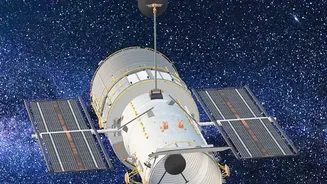
Modern telescopes like the Hubble Space Telescope and the James Webb Space Telescope are technological marvels, peering deeper into space and time than humanity has ever seen. But with this incredible power comes an equally incredible amount of information.
Every day, NASA collects a torrent of data—images, light spectra, and telemetry—far exceeding what human researchers could ever hope to analyze manually. In July 2026, NASA announced its participation in the Genesis Mission, a federal initiative to process over 150 petabytes of space data using AI. This highlights a fundamental challenge in modern astronomy: discoveries aren't just waiting to be seen, they're often buried in mountains of data, waiting to be found. For years, the bottleneck in astronomy has been shifting from data collection to data analysis.
An AI Assistant for Astronomers
This is where machine learning (ML) comes in. Think of it not as a replacement for human scientists, but as a tireless and incredibly fast assistant. These AI algorithms, particularly neural networks, are trained on vast, existing datasets that have already been classified by humans. For example, scientists feed an AI thousands of confirmed signals of a planet passing in front of its star. The AI learns the subtle patterns and characteristics of that event. Once trained, it can then sift through new, unanalyzed data at superhuman speeds, flagging potential discoveries that a human might miss or take years to find. It’s a powerful partnership, combining human expertise with machine-scale efficiency.
Hunting for Thousands of New Worlds
One of the most successful applications of ML at NASA has been in the hunt for exoplanets—planets orbiting other stars. Missions like the Kepler Space Telescope and its successor, TESS, have generated light curves from hundreds of thousands of stars. A dip in a star's brightness might signal a transiting planet, but it can also be caused by other phenomena. AI models like ExoMiner and RAVEN have revolutionized this process. After being trained on confirmed planet data, these systems analyze new datasets for tell-tale transit signals. In 2021, ExoMiner validated 301 new exoplanets. More recently, an updated version called ExoMiner++ began digging into TESS data, identifying thousands of new candidates. Another AI, RAVEN, recently confirmed over 100 exoplanets, including 31 entirely new worlds.
Classifying the Galactic Zoo
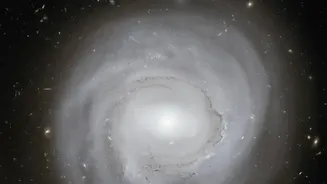
Beyond planet hunting, machine learning is essential for making sense of the universe's large-scale structures. Manually classifying the shapes and types of millions of galaxies is an impossibly tedious task. Deep learning algorithms can be trained on images of known galaxy types—spirals, ellipticals, and irregulars—and then set loose on vast sky surveys. These systems can classify hundreds of thousands of galaxies with high accuracy, helping astronomers build a more complete census of the cosmos and understand how galaxies form and evolve over billions of years. Citizen science projects like Galaxy Zoo often provide the initial labeled data needed to train these powerful AI models, creating a virtuous cycle of human and machine collaboration.
Finding the 'Weird' and Wonderful
Perhaps the most exciting frontier for AI in astronomy is its ability to find things scientists weren't even looking for. By design, these systems are pattern-recognition engines. When they encounter something that doesn't fit any known pattern, they can flag it as an anomaly. Recently, an AI tool called AnomalyMatch was used to scan nearly 100 million image cutouts from the Hubble archives. In just a few days, it identified over 1,300 strange objects, including rare galactic mergers, gravitational lenses, and several dozen phenomena that defied existing classifications entirely. This opens the door to discovering entirely new types of cosmic objects and events, pushing the boundaries of our knowledge.