




The Treasure in the Shadows
The idea of water on the Moon isn't entirely new, but for a long time, it was just a theory. The game truly changed in 2008 thanks to India's first lunar probe, Chandrayaan-1. An instrument from NASA aboard the Indian spacecraft, the Moon Mineralogy Mapper
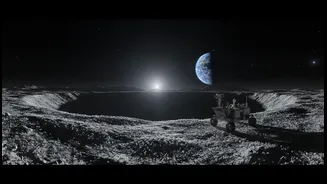
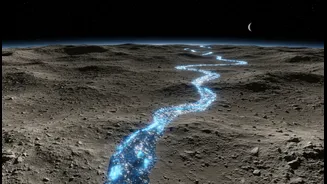
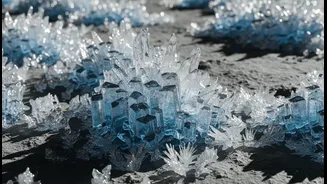
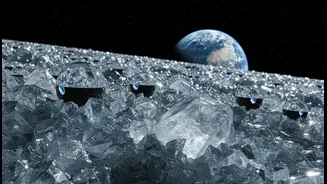
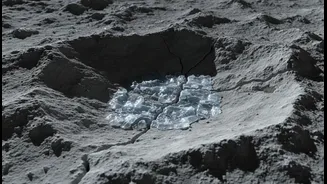
(M3), provided the first definitive proof of water molecules on the lunar surface. This discovery was monumental. It confirmed that the Moon wasn't the bone-dry desert we once thought. This water exists mainly as ice, hidden away in Permanently Shadowed Regions (PSRs) near the poles. These are craters and depressions where sunlight has not reached for potentially billions of years, creating super-cold traps that preserve the ice. Recent studies, including analysis from ISRO scientists, suggest that the amount of subsurface ice in the first few meters could be 5 to 8 times larger than the ice found on the surface.
The Ultimate Off-World Resource
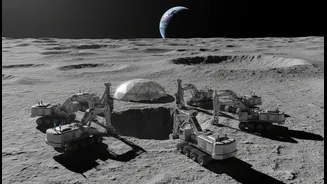
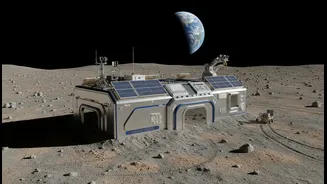
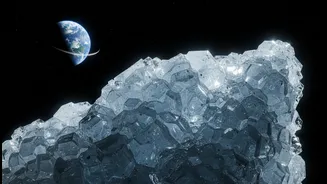
So, why is finding frozen water such a big deal? Because water is the most valuable resource in space. Its discovery on the Moon is like finding an oasis in the desert or, perhaps more accurately, a petrol pump on the highway to the stars. The applications are transformative. First, it provides drinking water and breathable oxygen for astronauts, dramatically reducing the supplies that need to be launched from Earth. This makes longer missions and even permanent lunar habitats far more feasible. Second, and most critically for exploration, water (H2O) can be split into its component parts: hydrogen and oxygen. These two elements are the primary components of modern rocket propellant. The ability to mine ice and produce fuel on the Moon—a concept known as In-Situ Resource Utilisation (ISRU)—would revolutionise space travel, turning the Moon into a refuelling station for missions deeper into the solar system, including Mars.
India’s Pioneering Role Continues
India’s role in this discovery, initiated by Chandrayaan-1, has continued to be central. After the historic landing of Chandrayaan-3 near the south pole in 2023, ISRO's focus has sharpened on lunar resources. The Chandrayaan-2 orbiter, which is still actively circling the Moon, has been using its advanced radar to peer beneath the surface. Recent findings from this data suggest strong evidence of subsurface ice deposits, which are more stable and protected from the harsh space environment than surface ice. Building on this legacy, ISRO is planning its most ambitious lunar mission yet: Chandrayaan-4. Scheduled for around 2028, this mission aims to land near the south pole, collect surface and drilled soil samples, and return them to Earth. This would make India only the fourth country to achieve such a feat and would provide the first-ever samples from the Moon's polar regions, which are of immense global interest.
From Science to a Strategic Blueprint
The knowledge gained from these missions provides a practical blueprint for India's long-term space ambitions. Knowing the location, quantity, and depth of water ice is crucial for planning future missions that can actually use it. This includes designing rovers with drills capable of extracting samples from several meters underground, where ice is believed to be more plentiful. The upcoming Chandrayaan-4 and the collaborative LUPEX (Lunar Polar Exploration) mission with Japan's space agency, JAXA, are direct results of this strategic shift. The LUPEX mission will feature a rover designed to survive the frigid lunar night and carry instruments, including a NASA-provided Neutron Spectrometer System, specifically to detect and characterise water deposits under the surface. These missions are not just for scientific curiosity; they are technology demonstrators aimed at mastering the techniques needed to live and work on the Moon.