






The Misconception of Distance
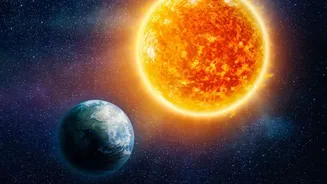
Many people believe that seasons change because Earth's distance from the sun varies, getting closer for summer and farther for winter. While it sounds logical, this is a common misconception. Earth's orbit is slightly elliptical, not a perfect circle,
so our distance from the sun does change. However, the planet is actually closest to the sun in early January, during the Northern Hemisphere's winter, and farthest away in early July, at the peak of summer. This fact alone proves that distance is not the primary driver of our seasons. The real reason is much more elegant: Earth's axial tilt.
It's All About the Tilt
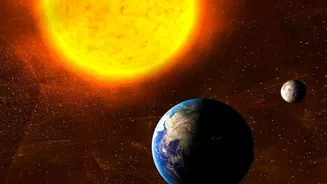
The true cause of the seasons is that Earth is tilted on its axis by about 23.5 degrees. This tilt remains constant as our planet journeys around the sun. Because of this slant, different parts of the globe receive the sun's most direct rays at different times of the year. When the Northern Hemisphere is tilted toward the sun, it receives more concentrated, direct sunlight, leading to longer days and warmer temperatures—what we call summer. At the same time, the Southern Hemisphere is tilted away, getting less direct, spread-out sunlight, which results in the shorter, cooler days of winter. Six months later, as Earth continues its orbit, the situation is reversed.
What is an Equinox?
Twice a year, in March and September, Earth reaches a point in its orbit where its axis isn't tilted toward or away from the sun. Instead, the tilt is perpendicular to the sun's rays. On these days, the sun shines directly over the Earth's equator. This moment is called an equinox, a name derived from Latin for "equal night," because day and night are approximately the same length all across the globe. During an equinox, both the Northern and Southern Hemispheres receive the sun's rays about equally. It's a moment of global balance before one hemisphere begins to tilt more decisively toward the sun and the other tilts away.
The September Equinox Explained
The September equinox marks the specific moment when the sun crosses the celestial equator—an imaginary line in the sky above Earth's equator—moving from north to south. In 2026, this event will occur on September 23. For the Northern Hemisphere, this signals the start of astronomical autumn. Days will begin to get noticeably shorter and the nights longer, continuing until the winter solstice in December. Conversely, for the Southern Hemisphere, the September equinox marks the beginning of spring, as it starts its tilt toward the sun. It's a celestial turning point that officially transitions us from the light-filled days of summer to the milder, golden days of autumn.
Observable Effects and Cultural Notes
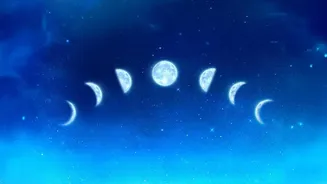
Beyond the change in temperature, the equinox brings observable phenomena. On the day of an equinox, the sun rises almost exactly due east and sets almost exactly due west, no matter where you are on Earth. While the name "equinox" suggests equal day and night, in reality, most places see slightly more than 12 hours of daylight. This is because of the way Earth's atmosphere refracts sunlight, and how sunrise and sunset are defined. Culturally, the autumnal equinox has been significant for centuries, often associated with harvest festivals. The full moon nearest to the September equinox is famously known as the Harvest Moon, historically providing farmers with extra light to bring in their crops.